AI Agent Memory Systems: How Agents Store, Retrieve, and Use Information
Why agent memory is a system, not a feature
A language model starts each call with the context it’s given; it doesn’t automatically carry yesterday’s decisions into today’s request. That’s fine for a one-off answer. It becomes a real constraint when an AI agent must track what it has done, retain a user’s preferences, or continue work across several steps. The key idea is simple: language models don’t retain information between calls, so agents need a separate memory system. It stores information outside the model’s context window and brings relevant pieces back when needed. That design choice is more significant than it looks: memory affects whether an agent can resume a task, avoid repeating work, and use past information reliably. This article examines the building blocks of agent memory, the practical choices involved in storing and retrieving information, and the ways frameworks organize memory and handle changing facts.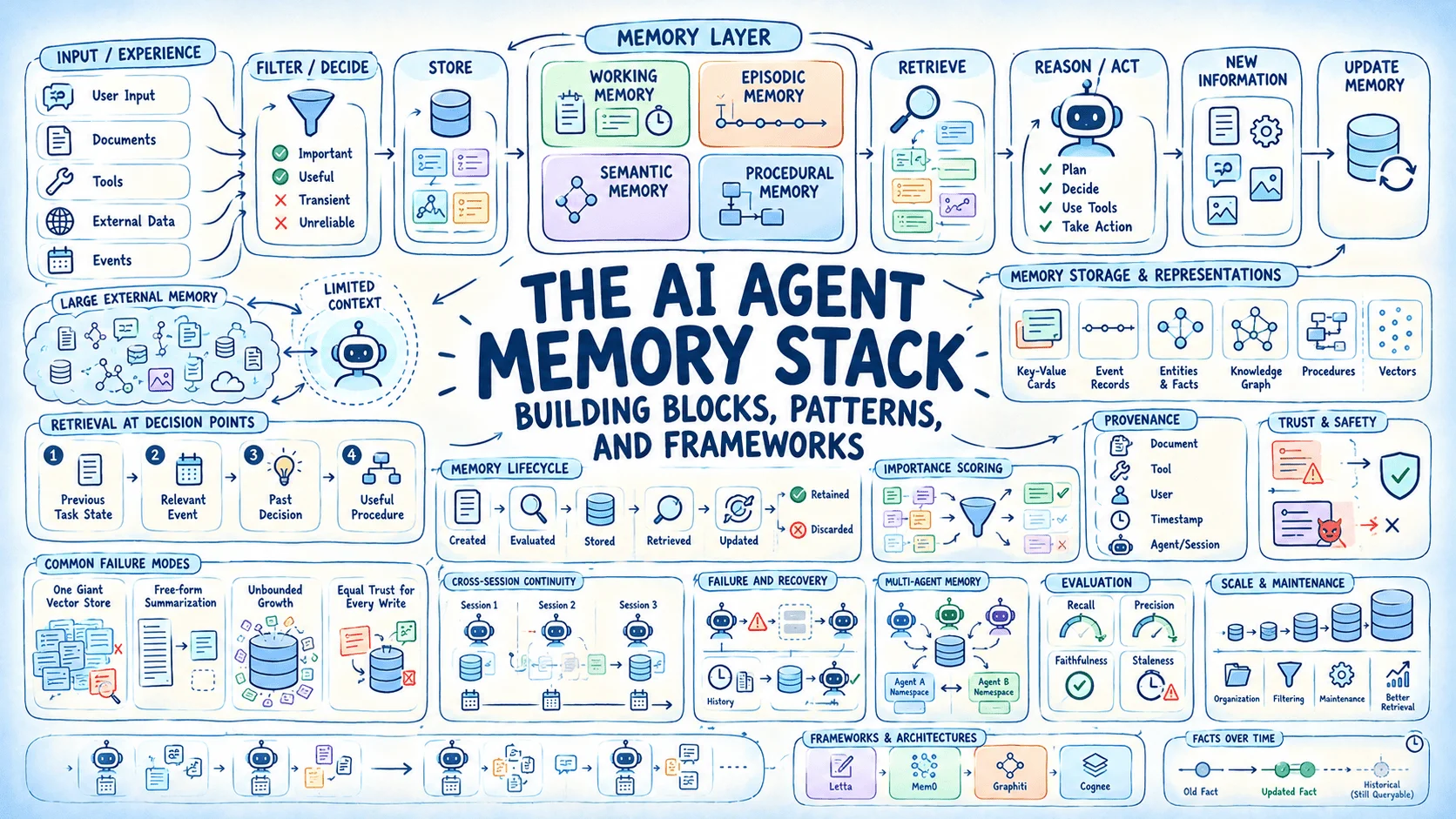
Four kinds of information to remember
“Memory” can mean several different things. An agent may need temporary task state, a record of past events, durable facts, or instructions about how to act. Those needs call for different storage and retrieval choices; putting everything in one bucket can make the right information harder to find. Agent memory is commonly divided into four types: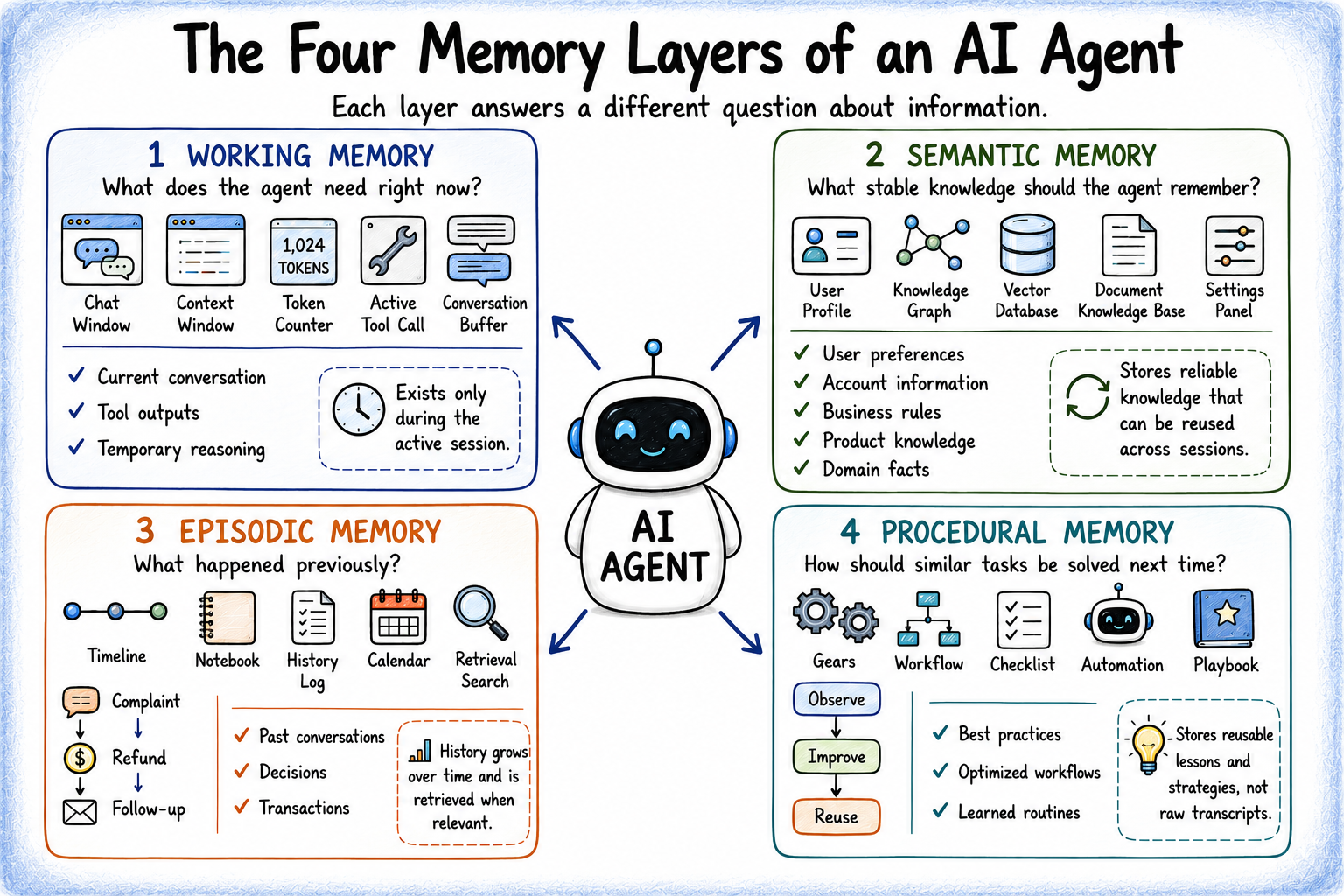
| Memory Type | What It Holds | Storage Layer | Retrieval Method |
|---|---|---|---|
| Working | Active task state: intermediate results, scratchpad values | In-memory or short-lived key-value store | Direct lookup by key |
| Episodic | What happened: past interactions, task runs, decisions made | Time-ordered log or vector store | Semantic similarity search |
| Semantic | What is true: facts and preferences that get updated rather than appended | Key-value or entity store | Exact lookup by attribute, sometimes combined with semantic search |
| Procedural | How to do things: successful action patterns, known failure modes | Prompt templates or fine-tuning | Pattern match or direct injection |
Memory has to keep up with the task
Consider a research agent working over several days: it gathers sources, extracts claims, drafts sections, then repeats the cycle. After each step, it can put results in working memory with a short expiry and attach basic metadata, such as the producing tool and session. If an observation proves valuable, the agent can promote it to episodic memory with an importance score. Disposable notes can expire; decisions that affect later work can persist.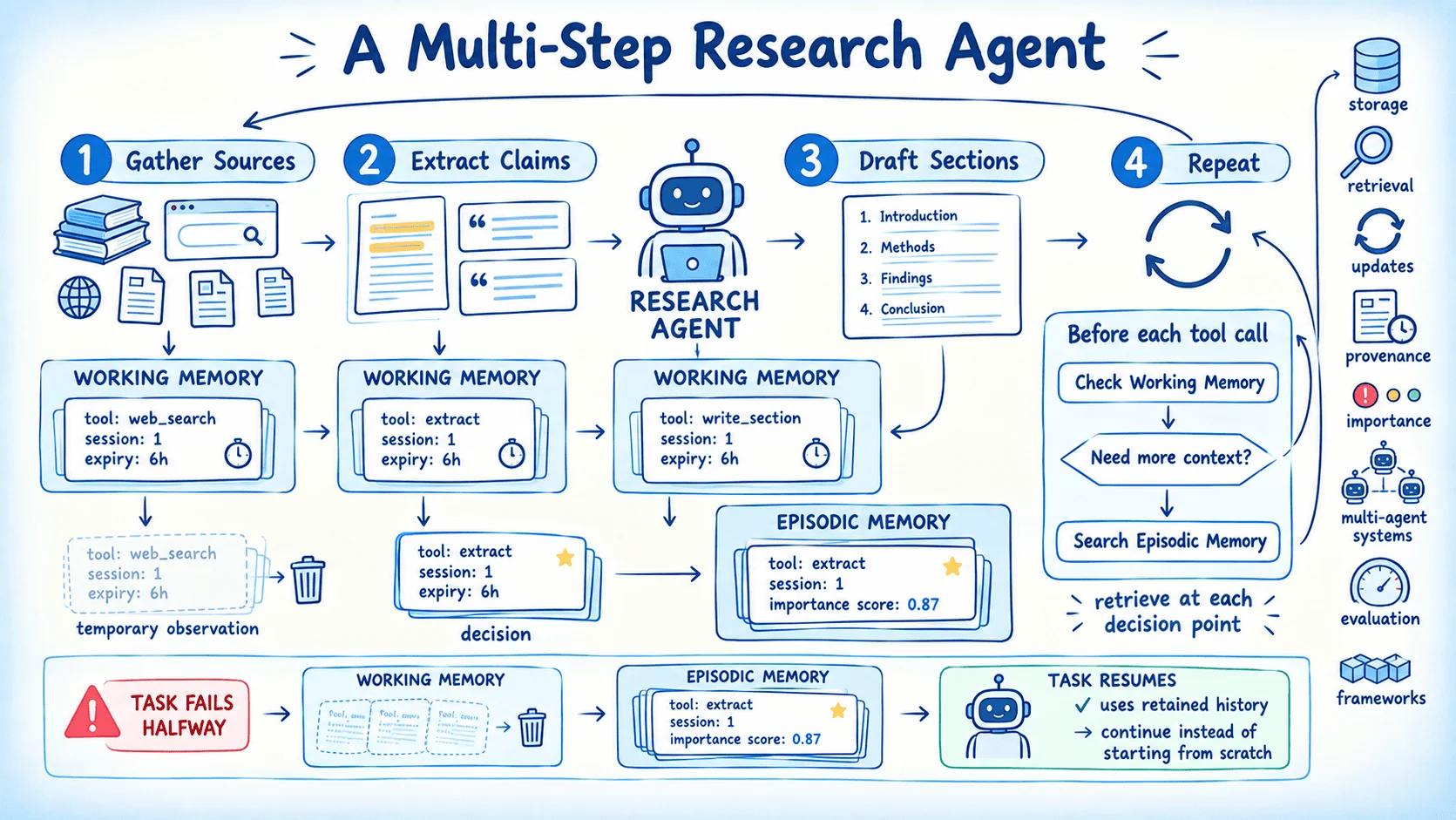
- Rate importance before saving, so fleeting observations and low-value tool outputs don’t crowd out information likely to matter later.
- Limit each agent’s memory to its role in a multi-agent system, reducing irrelevant or conflicting entries.
- Refresh retrieved context at decision points throughout a workflow.
- Record provenance, including the source agent, tool, user input, or timestamp, to make entries easier to debug and audit.
| Approach | Why It Fails |
|---|---|
| Embedding everything into one vector store | Retrieves information that is semantically similar but not necessarily relevant to the task, while making relationships between facts difficult to represent. |
| Free-form summarization as memory compression | Can remove specific details, constraints, or numbers that become important later, and may preserve an incorrect statement as if it were verified. |
| Unbounded memory growth with no maintenance | Causes irrelevant entries to compete with useful ones, reducing retrieval quality while increasing storage and maintenance costs. |
| Trusting every write equally | Creates a risk of memory poisoning, where untrusted or adversarial content is stored and later treated as reliable information. |
Frameworks make different tradeoffs
The design principles above can be implemented in many ways. Frameworks package choices about storage, retrieval, structure, and maintenance. The examples here show several approaches, though they aren’t a complete list; the agent memory frameworks round-up covers more options. Some systems store editable text, while others build entity-aware retrieval or knowledge graphs. Those choices shape how the agent finds related facts and handles changes over time:| Framework | Memory Model | Handles Fact Changes By |
|---|---|---|
| Letta | Self-editing text blocks that the agent can rewrite directly | The model identifies a contradiction and updates the block |
| Mem0 | Vector-based memory with entity-aware retrieval | New memories are added and retrieved alongside existing ones |
| Graphiti | Bi-temporal knowledge graph with typed relationships between entities | Invalidating older relationships while keeping their history queryable |
| Cognee | Extraction pipeline that builds graph, vector, and relational layers from source data | Rebuilding the memory representation, with temporal modes for tracking changes |
What to measure as memory scales
Memory quality gets harder to manage when agents share a store or run for longer periods. Shared writes can collide, so teams need a policy: control writes through a central service, give each agent its own namespace, or keep an append-only log and resolve conflicts when retrieving information.
Four measures help show whether that system is working. Recall tracks whether relevant memories turn up; precision tracks how much unrelated material comes with them. Faithfulness asks whether the agent reasons correctly from what it retrieved, while staleness captures how often outdated information resurfaces. These metrics expose different failure modes, and no single one tells the whole story.
For a deeper look at shared memory, see Why Multi-Agent Systems Need Memory Engineering from MongoDB, or take DeepLearning.AI’s course, Building Memory-Aware Agents.
Choosing an approach
Agent memory is an architectural layer: it determines what information persists across calls, tasks, and sessions, and how that information is stored, retrieved, updated, and retired. The article has covered memory types and design patterns, along with common failure modes and the tradeoffs among frameworks. Longer-running and multi-agent setups add their own demands, particularly around evaluation, consistency, and ongoing maintenance.
There’s no universal design that fits every agent. The right choice depends on the workload, the data, and the operational constraints. If you’re weighing options for a particular use case, Choosing the Right AI Agent Memory Strategy: A Decision-Tree Approach offers a way to narrow them down.


