How to Choose the Right LLM Inference Optimization Technique
Choosing an LLM Inference Optimization Technique: A Decision-Tree Approach
By Bala Priya C · November 3, 2026 · Language Models
Start with the bottleneck
The hard part of speeding up LLM inference isn’t finding an optimization technique. It’s identifying which one fits your workload. A method that saves memory won’t necessarily cut token latency, and a more complex serving architecture can add overhead without fixing the actual constraint.
As traffic grows, requests queue behind long generations, the KV cache fills GPU memory, and memory reads can leave compute resources waiting. Inference optimization covers techniques that address these different pressures: memory use, compute, and request scheduling. This article uses six questions about your model and traffic to guide the choice, then compares the techniques’ trade-offs and warning signs.
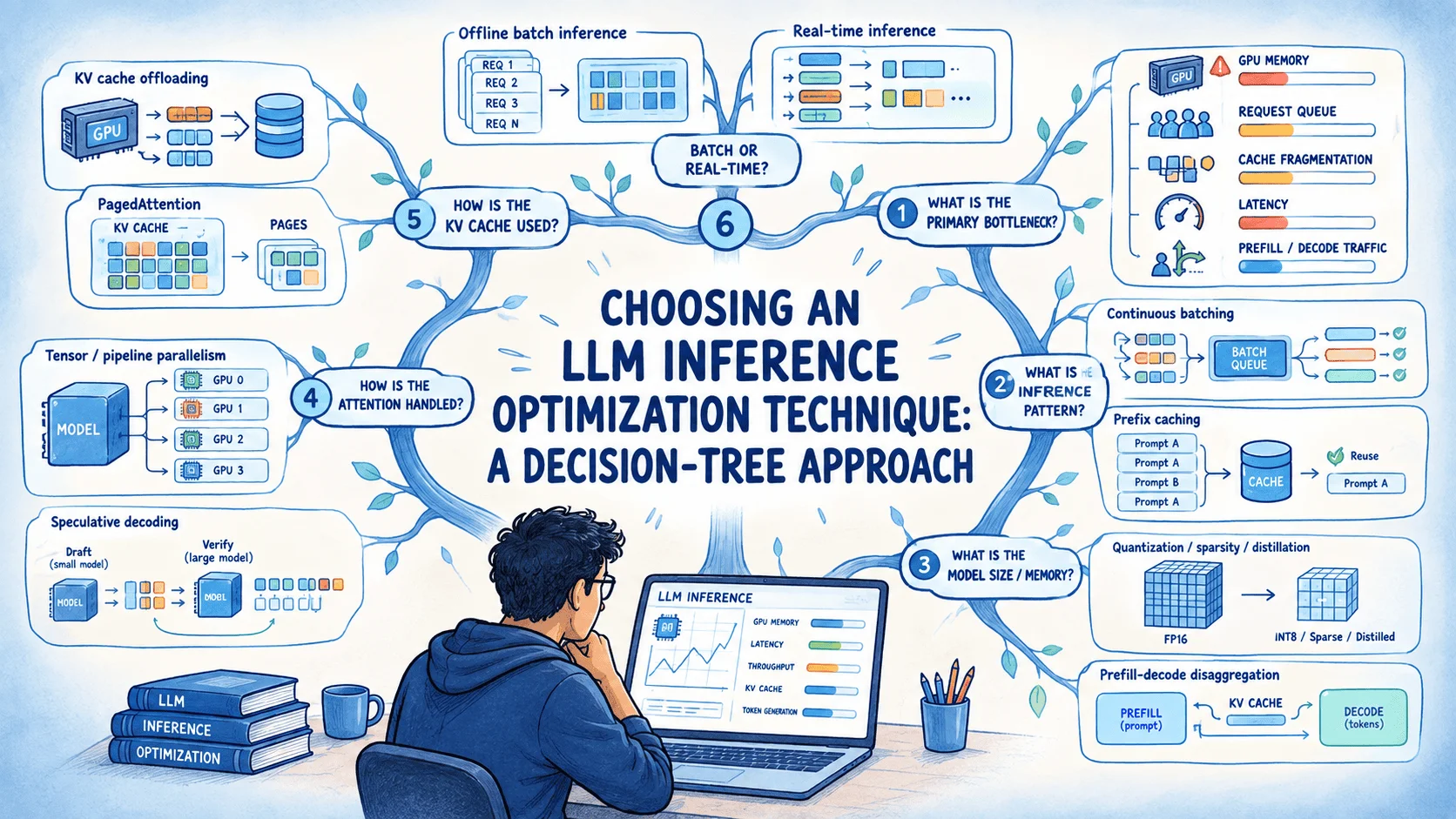
Here’s the thing: each technique starts from a particular assumption about your workload. If that assumption doesn’t hold, the optimization may add complexity without delivering much benefit.
| Technique | What It Assumes |
|---|---|
| Quantization / sparsity / distillation | The model is too large for available hardware or the latency budget, and reducing its size is worth some risk to accuracy. |
| Prefix caching | Many requests begin with the same token sequence, making repeated computation of that prefix wasteful. |
| Continuous (in-flight) batching | Requests overlap in time and produce different amounts of output, so holding a batch until its longest request finishes wastes GPU capacity. |
| PagedAttention | KV cache memory is fragmented or reserved inefficiently, limiting batch size below the hardware’s potential. |
| Speculative decoding | Decode is the bottleneck, and a cheaper draft model can correctly predict multiple tokens for the main model to verify together. |
| Prefill-decode disaggregation | Prefill and decode compete for the same GPU, harming both time-to-first-token and inter-token latency. |
| Tensor / pipeline parallelism | The model cannot fit in one device’s memory, or one device’s compute limits throughput. |
| KV cache offloading | GPU memory pressure evicts cache entries that would otherwise be useful. |
| Offline batch inference | Responses don’t need to be interactive, so total throughput matters more than per-request latency. |
That’s the logic behind the decision tree: diagnose the constraint first, then choose the technique whose assumptions match your model and traffic.
Six questions to narrow the choice
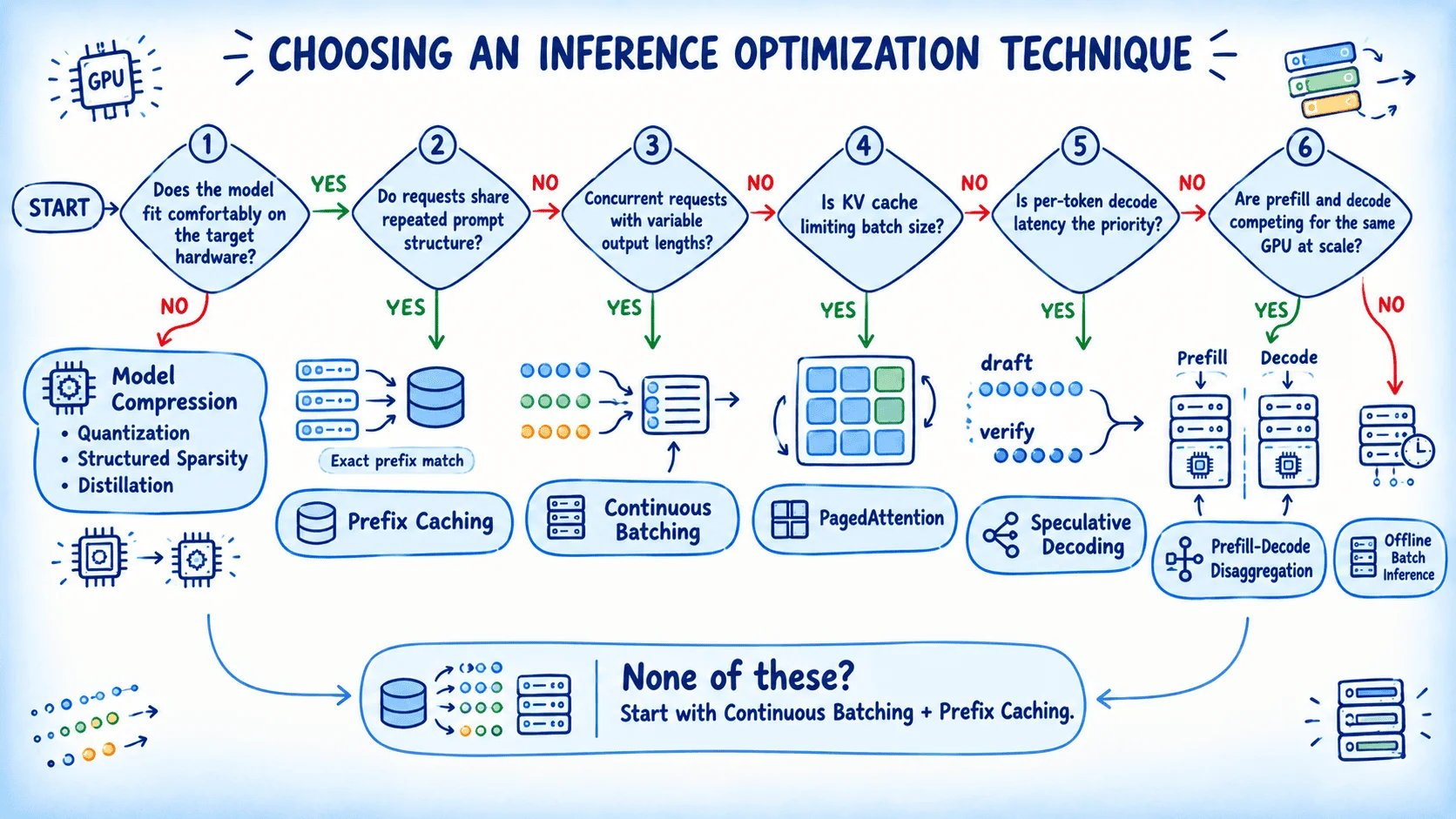
1. Does the model fit comfortably on the target hardware?
Begin with the model itself. If it barely fits in GPU memory, there may be little room left for the KV cache, which can cap batch size regardless of how well the scheduler works.
When the model is too large, or inference is compute-bound even at batch size one, consider model compression: quantization lowers the precision of weights and activations; structured sparsity removes less important weights to reduce computation; and distillation trains a smaller model to imitate a larger one. These choices are mostly independent of the serving stack, and they affect how much hardware capacity remains for serving.
If the model fits with room to spare, continue to prompt reuse.
2. Do requests repeat the same prompt content?
Chat systems often send the conversation history with every turn. Agent frameworks may reuse a system prompt across thousands of calls, while retrieval-augmented generation (RAG) pipelines can prepend the same instructions to different retrieved material.
When a meaningful share of requests has an identical prefix, prefix caching avoids rebuilding the KV cache for tokens the model has already processed. The benefit can grow with longer conversations. But the match must be exact, character for character: keep reusable text at the start of the prompt and put changing content after it.
If most prompts are unique, look at how requests overlap instead.
3. Do requests arrive together and finish at different times?
A one-sentence support reply and a code response hundreds of lines long won’t finish together just because they started in the same batch. With static batching, faster requests can leave the GPU waiting for the slowest one.
Continuous batching lets completed sequences exit immediately and admits new requests without waiting for a batch to end. It suits overlapping traffic with variable generation lengths, and most serving engines turn it on by default. If your traffic is already well-batched and GPU idle time isn’t a problem, check memory use next.
4. Is KV cache fragmentation constraining batch size?
Some engines reserve a large contiguous memory block for each request, sized for its maximum possible sequence length. Shorter requests leave much of that reservation unused, where it remains unavailable to others.
PagedAttention breaks the KV cache into fixed-size pages so memory can be allocated in smaller units. It can help when fragmentation or over-allocation limits batch size. Most modern serving engines support it, so check whether it’s already enabled before changing configuration.
5. Is faster token streaming more important than aggregate throughput?
If the goal is to reduce the pause between tokens for an individual user, consider speculative decoding. A smaller draft model proposes several tokens; the main model checks them in one pass. Correct guesses can collapse several sequential decode steps into one verification pass.
The catch is the extra model and verification work. Without a suitable draft model, or when its guesses are often rejected, the added complexity may not pay for itself. If that’s your situation, assess competition between prefill and decode.
6. Are prefill and decode competing for GPU time at scale?
This question matters most in production systems where a serving architecture change is practical. Long prompt processing can delay token generation, affecting both time-to-first-token and inter-token latency.
Prefill-decode disaggregation assigns the two phases to separate hardware: prefill nodes process prompts, then send the KV cache to decode nodes built for token generation. That transfer and the routing it requires add cost, so the traffic needs to justify the change. For smaller workloads or requests without interactive response requirements, offline batch inference may be simpler. If none of the conditions above fits, start by checking continuous batching and prefix caching.
Match each technique to its trade-off
The decision tree points to a likely fit, but the cost still matters. Quantization, for example, can reduce model size while risking accuracy; disaggregation can isolate phases while adding network traffic and routing work.
| Technique | Best For | Trade-off |
|---|---|---|
| Quantization / sparsity / distillation | Models that exceed hardware capacity or the latency budget | Possible accuracy loss; quantizing activations is harder to get right than quantizing weights. |
| Prefix caching | Chat, agent, and RAG workloads with repeated prompt structure | Any character-level mismatch breaks the shared prefix match. |
| Continuous batching | Concurrent requests with variable output lengths | Little downside; first check whether it’s enabled. |
| PagedAttention | Workloads limited by KV cache fragmentation | Adds a page-table layer to attention computation. |
| Speculative decoding | Latency-sensitive generation for individual users | Needs a draft model with a high enough acceptance rate to justify its overhead. |
| Prefill-decode disaggregation | Large workloads where both phases compete for the same GPU | KV cache transfer adds network cost; separate nodes also require routing. |
| Tensor / pipeline parallelism | Models that cannot fit on one device | Pipeline bubbles and communication between devices. |
| KV cache offloading | Long-context or high-concurrency workloads short on GPU cache memory | Retrieving offloaded cache adds latency. |
| Offline batch inference | Non-interactive work where total throughput takes priority | Doesn’t suit tasks with strict response-time requirements. |
Watch for signs the choice isn’t working
Even a sensible technique can disappoint when its underlying assumption doesn’t hold. The next step is to look at the symptoms and decide what to check first.
Diagnose the regression before adding another optimization
| Symptom | Likely Cause | Fix |
|---|---|---|
| Repeated prompts produce almost no prefix-cache hits | The context may serialize differently between requests, or changing content may appear near the beginning of the prompt | Put stable material first and make serialized context ordering deterministic |
| Batch size stays low despite available memory | PagedAttention may be off, or its page size may be set incorrectly | Inspect the serving engine’s batching and cache settings instead of relying on defaults |
| Speculative decoding runs slower than standard decoding | The target model rejects too many tokens proposed by the draft model | Try a draft model whose behavior is closer to the target, or disable speculation for this workload |
| Disaggregation increases latency | The workload may be too small, or dominated by short requests that reuse cached content | Return to local prefill and set a traffic threshold for reconsidering disaggregation |
| Quantization fails to improve throughput | Weights may be quantized while activations remain full precision, with the GPU converting values back before computation | Profile the workload to locate time spent before expecting quantization to raise throughput |
These failures point to a useful rule: when an optimization disappoints, test the assumption behind it before stacking on more machinery.
Match the technique to the bottleneck
The choice of inference optimization depends on what is constraining the system. Model size, repeated prompt content, concurrent traffic, memory fragmentation, and the tradeoff between throughput and latency per user can each lead to a different choice. Most deployments will combine several techniques; no single setting is likely to solve every bottleneck.
If you want a broader guide to the subject, see The Roadmap to Mastering LLM Inference Optimization.
Happy learning!