AI Automation Shifts Work Toward Oversight, Verification and Harder Decisions
AI can clear routine work from a team’s queue, but that doesn’t mean the human workload disappears. It often shifts toward monitoring systems, checking their output and making decisions in the cases they handle poorly. Those tasks can be harder to measure—and, when a system fails, harder to perform well.
That tension was described decades before generative AI arrived. In a 1983 paper, University College London psychologist Lisanne Bainbridge argued that automation leaves people with the tasks its designers couldn’t automate, along with the job of watching systems that may need attention only rarely. Her analysis of industrial processes now speaks directly to teams assigning work to AI agents.
Project plans can estimate the hours an AI tool might save. They’re less likely to account for the attention required to check its answers or take over when it misses something. That gap matters: automation changes the shape of human work, and its costs depend partly on what the system takes over and what people are left to handle.
Monitoring takes sustained effort
Watching an automated system is easy to mistake for passive work. Research on vigilance suggests otherwise. A 2008 review by J. S. Warm, R. Parasuraman and G. Matthews brought together behavioral, neural and self-reported measures. The findings pointed in the same direction: vigilance demands substantial mental effort and can be stressful. It can also lower engagement and increase distress.
That research comes from experimental settings, but it raises a practical question for any automation project: who will supply the attention the system still requires, and under what conditions? Monitoring an uneventful process can be tiring precisely because people must stay ready to notice an event that may not come.
Generative AI makes the question part of ordinary knowledge work. In a 2025 survey, researchers from Microsoft Research and Carnegie Mellon University asked 319 knowledge workers about their use of generative AI. Participants said critical thinking was shifting toward checking information, combining AI responses and keeping the task on track. The findings describe workers’ perceptions; they don’t directly measure what those people did.
A separate study offers an observational view. Xingqi Maggie Ye and Aruna Ranganathan of Berkeley Haas spent eight months studying a 200-person technology company where employees had broad access to generative AI tools. Their ethnographic work also drew on more than 40 interviews. They found that employees often used the time they gained to take on more work, broaden their responsibilities and work across more hours of the day, sometimes without being asked. The researchers said that expansion appeared to come from employees themselves in many cases. It’s evidence from one company and ongoing research, so it should be read as a signal rather than a universal pattern.
Perceived time savings can diverge from measured results
Even experienced users may not have a reliable sense of whether AI makes them faster. In a 2025 randomized study, METR researchers gave 16 experienced open-source developers 246 tasks drawn from projects they had known for an average of five years. With AI tools, the developers took 19% longer. Afterward, they estimated that AI had saved them 20% of their time.
The study was small, and the tools were those available between February and June 2025. Still, the gap between measured time and participants’ impressions is a useful warning for organizations evaluating AI through user feedback alone. A tool that feels fast may not shorten the full task, especially when the work includes review and correction.
Routine gains can leave people with tougher exceptions
AI’s effect on judgment is a separate question from its effect on speed. A 2014 meta-analysis by Linda Onnasch and colleagues combined results from 18 experiments on automation. As automation increased, routine performance improved. While the system worked, workload fell too, though by less. When it failed, participants’ performance and awareness of the situation declined. The authors called this the “lumberjack effect”: the higher the tree, the farther it falls. In all but four of the studies, participants were students.
Expertise doesn’t necessarily prevent people from being swayed by an AI recommendation. A 2023 experiment published in Radiology involved 27 radiologists reading mammograms with help from a system presented as AI. More experienced radiologists classified 82.3% of images correctly when the system was right, but 45.5% when it was wrong. Among less experienced readers, accuracy fell from 79.7% to 19.8%.
A 2017 systematic review by D. Lyell and E. Coiera examined research on human factors and healthcare. Of 40 studies included, six focused on health. The authors found that automation bias—the tendency to rely too heavily on decision support—could occur even in one-off tasks, particularly when checking an answer was complex. They linked that bias to the cognitive load of making a decision and suggested reducing that load.
Taken together, these studies point to a difficult feature of automation. When systems handle easy checks, people may be left with exceptions, ambiguous cases and mistakes the system hasn’t surfaced. There may be fewer decisions to make, but each one can be harder to resolve. That’s an interpretation of the evidence, not a result measured directly in these studies. It suggests that the work left behind could be especially vulnerable to overreliance on a machine.
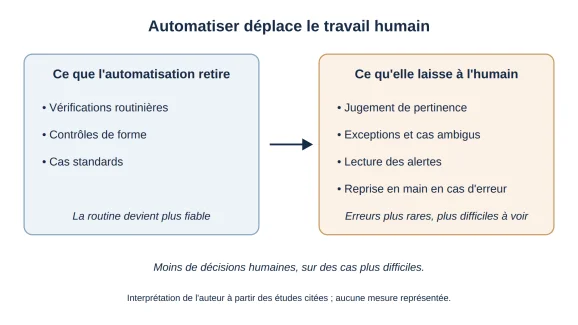
The author’s interpretation of what automation removes and leaves to human workers, based on the cited research. The diagram does not represent a measured result.
AI can reduce workload when it removes the right tasks
There’s substantial evidence that AI can make work easier. Erik Brynjolfsson, Danielle Li and Lindsey Raymond studied the staggered introduction of a generative AI conversational assistant among 5,172 customer service agents. Productivity, measured as issues resolved per hour, rose by an average of 15%, with marked differences by experience and skill. Less experienced and less skilled agents improved in both speed and quality. More experienced and skilled agents became slightly faster but saw a small decline in quality. The researchers also reported a better work experience: customers were more polite and less likely to ask for a manager.
Healthcare offers another example. A 2025 study in JAMA Network Open surveyed 263 clinicians from six US health systems before and after 30 days using the same AI scribe platform, which documents clinical consultations. The share reporting burnout fell from 51.9% to 38.8%, while the cognitive burden associated with notes also declined. The study had no control group, and three authors disclosed ties to Abridge AI, including two employees. Its findings are consistent with a reduction in administrative strain, though the study design limits what can be concluded.
These results don’t cancel out evidence about vigilance or automation bias. They help explain when AI may lighten work: a scribe can reduce documentation, and a conversational assistant can suggest responses. In my read, the key issue is how the tool divides tasks. The attention cost isn’t an inevitable feature of AI; it depends on whether the work removed is replaced by a more demanding burden of review.
What the evidence still can’t tell us
Several practical questions remain unanswered. The author found no study measuring whether effort per minute rises when people are left mainly with judgment tasks. The possibility is plausible, but the evidence is missing.
On fatigue among people supervising workplace AI, the article cites one direct source: a Boston Consulting Group study of 1,488 employees at large US companies, presented in Harvard Business Review. BCG advises companies on AI transformation, and the study said excessive AI use or constant monitoring can cause mental fatigue. That finding deserves attention, but a single study from an interested organization is a limited basis for general conclusions.
The author also found no peer-reviewed study measuring how workload changes as one person supervises a larger number of AI agents. That question will become more concrete as companies assign workers responsibility for fleets of automated systems.
Questions that make an automation plan more useful
Teams don’t need complete evidence to ask better questions before deployment. They can begin by defining the human work that follows automation:
- What will people still have to check? Identify the decisions left behind, and assess whether they’re more difficult than the work the system takes over.
- Who will perform those checks, and how much time is set aside? Without time for review, a sign-off can become a formality rather than a meaningful check.
- What happens when the system is wrong? Specify who is expected to notice the error and who can take control.
Time saved remains a useful measure, but it tells only part of the story. A sound assessment also counts the work of review, correction and supervision—and checks whether the people responsible have the time and expertise to do it. As AI handles more routine tasks, that human work may be less visible and more demanding. Organizations that measure it can make more grounded decisions about what to automate next.
This article was first published on Foundations and contributed to R-bloggers. You can report an issue about the content here.
Want to share your content on R-bloggers? Click here if you have a blog, or here if you don't.
To leave a comment for the author, follow the link and comment on their blog: Foundations.
Sources
- Lisanne Bainbridge, “Ironies of automation,” Automatica, 19(6), 1983, pp. 775–779: https://ckrybus.com/static/papers/Bainbridge_1983_Automatica.pdf
- J. S. Warm, R. Parasuraman and G. Matthews, “Vigilance requires hard mental work and is stressful,” Human Factors, 50(3), 2008, pp. 433–441: https://pubmed.ncbi.nlm.nih.gov/18689050/
- Hao-Ping (Hank) Lee et al., “The Impact of Generative AI on Critical Thinking: Self-Reported Reductions in Cognitive Effort and Confidence Effects From a Survey of Knowledge Workers,” CHI 2025: https://www.microsoft.com/en-us/research/publication/the-impact-of-generative-ai-on-critical-thinking-self-reported-reductions-in-cognitive-effort-and-confidence-effects-from-a-survey-of-knowledge-workers/
- Berkeley Haas, “AI promised to free up workers’ time. UC Berkeley Haas researchers found the opposite,” February 18, 2026, on ongoing work by Xingqi Maggie Ye and Aruna Ranganathan, also presented in Harvard Business Review: https://newsroom.haas.berkeley.edu/ai-promised-to-free-up-workers-time-uc-berkeley-haas-researchers-found-the-opposite/
- Joel Becker et al. (METR), “Measuring the Impact of Early-2025 AI on Experienced Open-Source Developer Productivity,” 2025: https://arxiv.org/abs/2507.09089
- Linda Onnasch, Christopher D. Wickens, Huiyang Li and Dietrich Manzey, “Human Performance Consequences of Stages and Levels of Automation: An Integrated Meta-Analysis,” Human Factors, 56(3), 2014, pp. 476–488: https://depositonce.tu-berlin.de/items/7df9879f-d77b-4f2b-8760-f0e3d174ca67/full
- Thomas Dratsch et al., “Automation Bias in Mammography: The Impact of Artificial Intelligence BI-RADS Suggestions on Reader Performance,” Radiology, 307(4), 2023, e222176: https://pubmed.ncbi.nlm.nih.gov/37129490/
- D. Lyell and E. Coiera, “Automation bias and verification complexity: a systematic review,” JAMIA, 24(2), 2017, pp. 423–431: https://pubmed.ncbi.nlm.nih.gov/27516495/
- Erik Brynjolfsson, Danielle Li and Lindsey Raymond, “Generative AI at Work,” Quarterly Journal of Economics, 140(2), 2025, pp. 889–942: https://doi.org/10.1093/qje/qjae044
- Kristine D. Olson et al., “Use of Ambient AI Scribes to Reduce Administrative Burden and Professional Burnout,” JAMA Network Open, 8(10), 2025, e2534976: https://pubmed.ncbi.nlm.nih.gov/41037268/
- BCG, “When Using AI Leads to ‘Brain Fry,’” March 5, 2026, presenting an article by Julie Bedard et al. in Harvard Business Review: https://www.bcg.com/news/5march2026-when-using-ai-leads-brain-fry
Study quotations originally published in other languages have been translated by the author.
R-bloggers.com offers daily email updates about R news and tutorials about learning R and other topics. Click here if you're looking to post or find an R/data-science job.
Want to share your content on R-bloggers? Click here if you have a blog, or here if you don't.
Continue reading: L’IA travaille. Il vous reste le plus difficile.