Mistral Large 4 Open Weights Target Coding and Cybersecurity Workloads

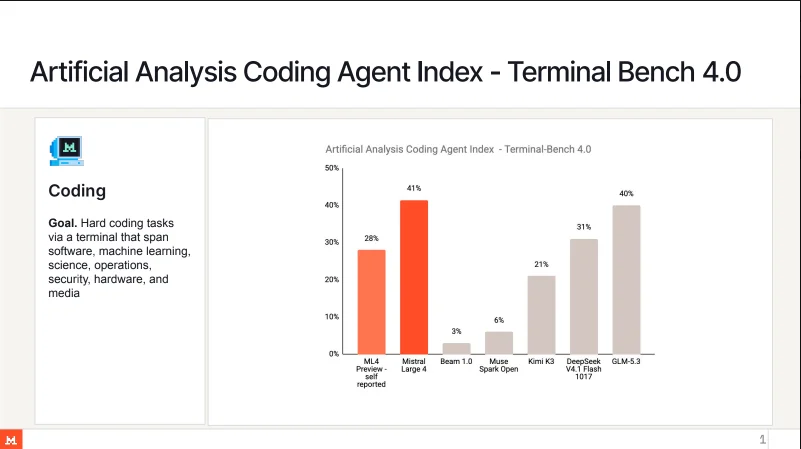
Mistral Large 4’s strongest case may be the combination of open weights, coding performance and lower reported token use. The French company released the model’s weights on Hugging Face on Thursday, three weeks after opening it for preview. Mistral says reinforcement learning and feedback from customers and partners raised its Terminal-Bench 4.0 result from 28% to 41%, edging GLM-5.3 by one percentage point.
That narrow coding lead matters less on its own than the efficiency claim attached to it. Mistral says Large 4, which it nicknames “Le Chonk,” uses 47% fewer tokens per task on average than GLM-5.3. If that holds in production workloads, teams could complete agentic coding tasks with lower usage and shorter runs. The company has not supplied independent evidence for the cost comparison, so buyers will need to measure the difference against their own prompts, tools and infrastructure.
Benchmarks point to coding and cyber strengths
Mistral’s coding comparison uses Terminal-Bench 4.0, part of Artificial Analysis’s Coding Agent Index. Large 4 scores 41%, compared with 40% for GLM-5.3, 21% for Kimi K3 and 6% for Muse Spark Open. The figures place Mistral’s model at the top of the open models shown in the company’s chart, but the one-point gap over GLM-5.3 makes this a close contest rather than a decisive separation.
Stock says the token difference helps explain why the benchmark score alone doesn’t tell the full story: “It means that you can get things done way faster and at a lower cost.” That’s Mistral’s interpretation of its efficiency data, not a general guarantee. Token counts can affect expense, but real operating costs also depend on serving prices, task success, retries and the surrounding agent stack.
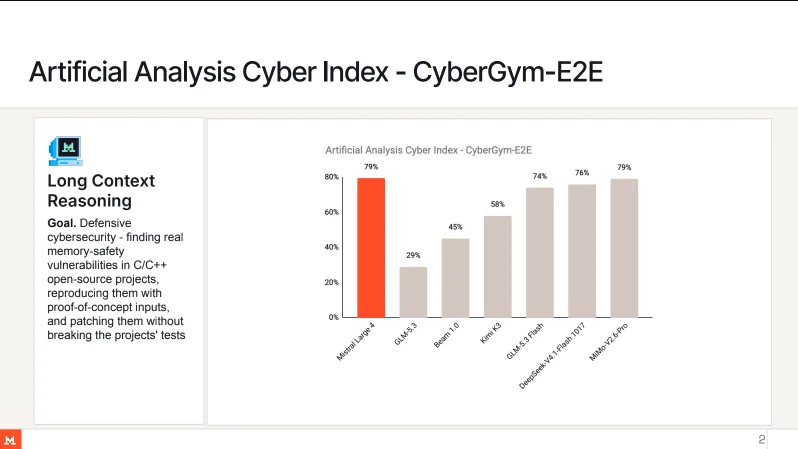
Cybersecurity is the other area Mistral says it prioritized during training. On CyberGym E2E in the Artificial Analysis Cyber Index, which measures defensive cybersecurity performance, Large 4 scored 79%. GLM-5.3 scored 29%, while GLM-5.3 Flash reached 74%. Mistral’s chart also shows DeepSeek v4.1 Flash 1017 at 76% and MiMo-V2.6-Pro at 79%, leaving Large 4 tied with the latter in this comparison.
Mistral connects those results to customer use cases such as automated penetration testing. In the example described by Pierre Stock, the company’s vice president of science, specialized agents inspect application logs and probe for possible entry points. For engineering teams, that points to a model intended to support workflows that span code analysis and security testing, though benchmark scores alone don’t establish how reliably it will perform on a particular environment.
Open weights as an operational choice
Mistral’s release also reflects a position on who should control access to AI systems. Stock said the company considers open weights important for business continuity, transparency and auditability. “I’m not comfortable living in a world in which open weights [don’t] exist,” he told reporters in an embargoed briefing attended by The New Stack.
He compared AI infrastructure to electricity: “Our stance is that AI is going to be like electricity. You don’t want to live in a world in which your neighbor or an oligopoly can cut off electricity from one day to another.” With weights available, organizations can run a model on their own systems or on infrastructure they trust, Stock said. That flexibility can reduce dependence on a single hosted service, though it doesn’t remove the need for computing resources or the operational work of running a model.
That distinction matters. Anthropic CEO and co-founder Dario Amodei has argued that open weights by themselves can’t resolve the concentration of AI power when access to compute remains concentrated. Mistral’s pitch addresses one part of that concern: users can retain more control over where a model runs, provided they can secure suitable hardware and expertise.
Stock also pointed to episodes involving access to hosted models, including OpenAI’s announced plans to cut off Cursor’s direct model access and the US government’s order concerning Anthropic’s Claude Fable 5 and Mythos 5. He described open weights as part of Mistral’s identity, adding that they help ensure “nobody can switch it off because it can run either on your infrastructure or on an infrastructure that you can trust.”
Training gains and resource claims
Large 4’s public preview followed roughly two months of training on about 3,800 Nvidia Grace Blackwell GPUs in Mistral’s European data centers. The company says it lifted the model’s Terminal-Bench 4.0 score from 28% to 41% during the three weeks after preview through reinforcement learning.
Stock said Mistral used 10 megawatts of power for that reinforcement learning phase, describing it as a fraction of competitors’ resource use. Asked how the company could verify that comparison, he replied: “I have no information about someone being able to do it with this amount of resources.” The statement offers Mistral’s account of its own training effort, but the source provides no comparable figures from rival labs.
Stock argued that efficiency could let Mistral make further progress as it raises resources. “If you give us 10 times more capital, then we’ll factor in these efficiency gains,” he said. The company’s broader ambition, he added, is to move from following the frontier to helping set it: “We want to be in a position in which we dictate the frontier.” He called Large 4 a stepping stone toward that goal.
A model family is next
Mistral expects to release smaller versions of Le Chonk in the coming months. Stock said the planned family will include a model that can run on a laptop, bringing the company’s open-weight approach to hardware with a smaller footprint. The source does not provide specifications or release dates for those versions.
The company sees potential uses in legacy software modernization, finance, manufacturing, industrial engineering and geospatial work. For software teams, Large 4’s benchmark results and token-efficiency claim make it a candidate for coding agents; for security teams, the CyberGym result supports testing it in defensive workflows such as automated assessment. Practical performance will depend on how each model handles a team’s code, tools and deployment constraints.
Stock framed Mistral’s longer-term direction as a push to control more of the technology stack: “We think the only way forward [is] to own the entire stack.” Large 4’s open release makes the immediate proposition tangible: teams can examine the weights and evaluate the model on their own infrastructure, while Mistral develops smaller variants and continues refining its frontier systems.


