Google Knowledge Catalog Connects Semantic Models to Ground AI Agents
Shared business definitions give AI agents a firmer footing
An AI assistant can write a plausible query and still return the wrong business answer. If it counts cancelled orders as revenue or queries an unvalidated staging table, a polished chart won’t make the result trustworthy. The gap is often business context: which metric definition, filters, tables and joins the organization has approved.
Google’s Knowledge Catalog is designed to give agents access to that context across data platforms. The service now generally supports semantic models and metric definitions from Looker LookML, BigQuery Graph, dbt MetricFlow, Snowflake Semantic Views, Databricks Metric Views and SAP Core Schema Notation (CSN). It connects those definitions with metadata such as schemas, lineage, data profiles and business glossary terms in a shared context graph.
The practical pitch is that teams can bring existing business logic into agent workflows without moving the underlying data or translating their models into a new language. When two systems define the same metric differently, the graph retains both definitions with their sources, giving data stewards a way to identify and resolve the discrepancy.
Google says internal benchmarks found that agents grounded in Knowledge Catalog were nearly four times more accurate, with up to 33% lower latency and up to 75% fewer tokens. Those figures describe internal benchmark results; the source doesn’t provide the test setup or workload details. Still, the direction is useful: supplying an agent with relevant definitions may reduce both avoidable query work and incorrect answers.

Side-by-side comparison of the same question in Gemini without Knowledge Catalog (left) and grounded in Knowledge Catalog (right). Highlights the grounded agent (right) giving an accurate response with less token and lower latency, compared to the agent without Knowledge Catalog (left) hallucinating and using more tokens with higher latency.
One graph connects definitions to the data behind them
Knowledge Catalog represents the data and semantic estate as a connected map. Tables, semantic models, glossary terms and data products appear as nodes. Relationships include lineage, associations, schema keys, joins inferred from query history and join paths declared in semantic models. The intended benefit is that an agent can move from a business concept to its formula and verified join path using connected metadata, rather than piecing together clues from separate tools.
Each supported source contributes a different kind of context:
- Looker LookML (GA): Live sync from Looker Core indexes models, explores, views and dashboards. The imported information includes compiled metric SQL, fan-out-safe join conditions, required filters and lineage from source tables to executive dashboards.
- BigQuery Graph (GA): The catalog indexes property graph definitions, node and edge tables, graph measures and business synonyms. Agents can use Graph Query Language (GQL) traversals to reason across connected entities.
- dbt MetricFlow (GA): The connection links source objects to dbt models and metrics, and brings in related filters, saved queries, quality test results, freshness SLAs and downstream exposures.
- Snowflake Semantic Views via Horizon Catalog (GA): Semantic dimensions, facts, metric formulas, relationships and synonyms can be paired with federated BigQuery or Google Cloud Lakehouse tables. The integration also includes Data Metric Function quality scorecards and PII masking tags.
- Databricks Metric Views via Unity Catalog (GA): Imported details include metric view definitions, measure formulas, scoping filters and join cardinalities, alongside table certification badges and Lakehouse Monitoring profiling results.
- SAP Core Schema Notation (CSN) via SAP Business Data Cloud (BDC) (GA): For SAP BDC Data Products federated through Google Cloud Lakehouse, the catalog captures business labels, dimension and cube patterns, default aggregations, currency and unit bindings, join associations and data sensitivity flags.
Keeping these relationships together matters because a metric is only as useful as the path to the data it describes. A LookML join, dbt exposure, Snowflake relationship and SAP association can be explored in the same graph, with links back to the physical tables involved. The graph preserves overlapping definitions with their provenance instead of silently replacing one with another. That gives stewards the information to compare them and decide which definition an agent should use.
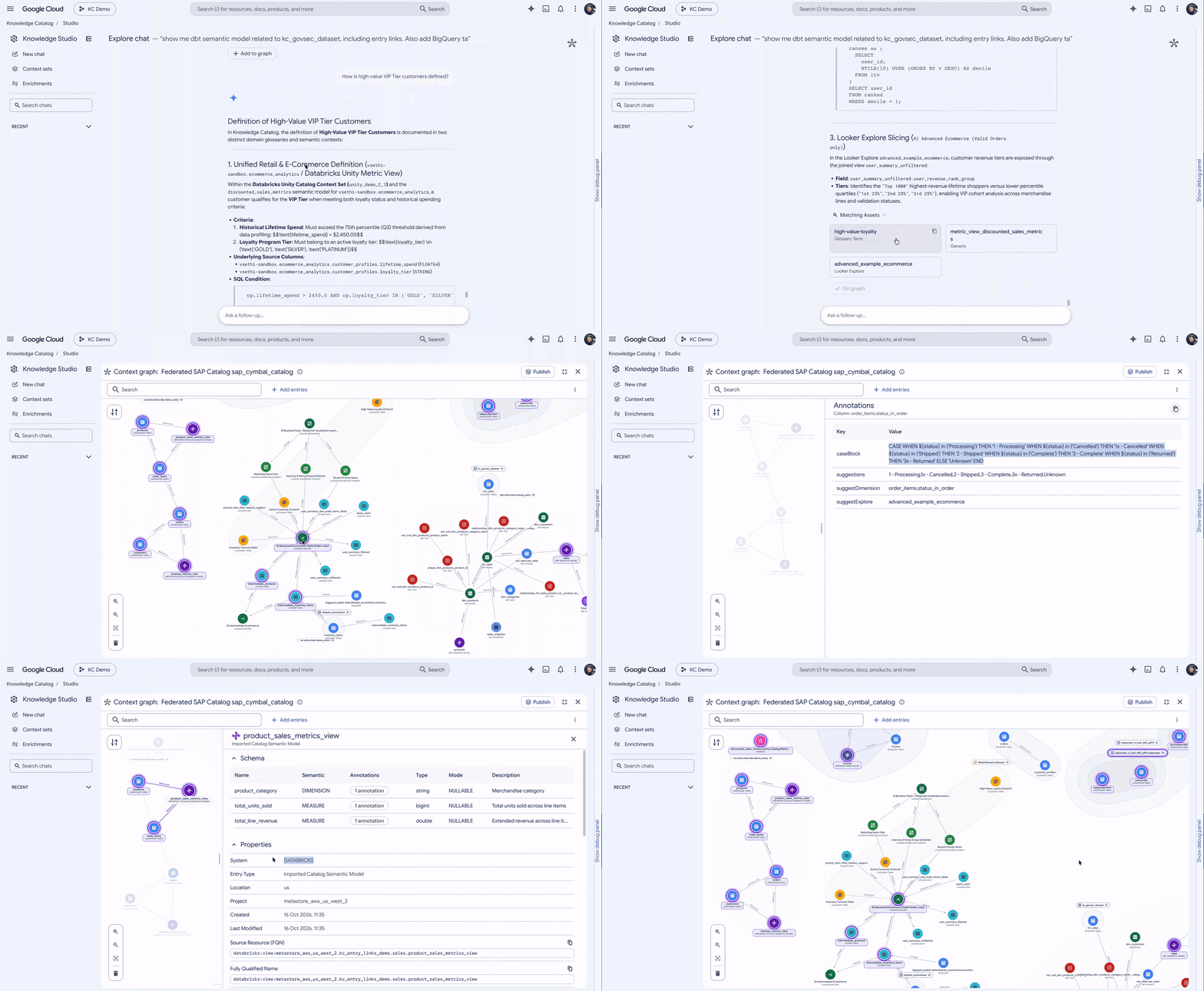
Navigating semantic models, join paths, and lineage on the context graph in Knowledge Studio.
Governed context can include more than formal metrics
Semantic models hold carefully defined metrics and key performance indicators, but not every useful instruction makes it into a model. Operational playbooks, meeting notes, chat threads and code can explain how teams interpret a metric or which conditions matter in a particular workflow.
Knowledge Catalog pairs structured definitions with context it extracts from these unstructured sources. Google describes this as self-learning enrichment powered by Gemini: it looks for missing or outdated context and turns relevant findings into governed, reusable context sets. The goal is to keep agent context current as definitions change, with less dependence on manual curation alone.
The graph also connects business logic to signals about the data itself. A valid formula can produce a misleading answer if it runs over stale or uncertified data. By linking semantic definitions to data quality scores, freshness signals and lineage, Knowledge Catalog can help an agent assess the underlying asset before generating SQL.
Knowledge Studio provides a place to inspect and package context
Teams can explore and manage the graph in Knowledge Studio, which is in preview. Its interface supports natural language exploration of semantic definitions and lets users trace connections on a context graph canvas. After validating the relevant assets and definitions, teams can package them into context sets for particular business domains or use cases. Gemini and custom agents can then consume those sets in production.
Knowledge Catalog is intended to ground Gemini agents, BigQuery Conversational Analytics and custom-built agents in the metrics, filters and join paths that teams already maintain. The new integrations expand the reach of that approach across six semantic model sources, while the shared graph gives stewards a way to inspect where definitions came from and how they connect to data.
For a question such as net revenue for top enterprise accounts, the agent can look up the trusted metric, apply its defined filters, follow the right join keys and check whether the underlying data passed quality checks. That’s the operational test for this release: whether an organization can make its existing business logic available to agents in a form they can act on—and keep that context visible as the data estate changes. Teams can explore the graph in Knowledge Studio and find setup guidance in the Knowledge Catalog documentation.