Microsoft’s Streaming Voice AI Starts Processing Speech Before You Finish

Microsoft’s latest voice models target a practical bottleneck in conversational software: the delay between a person speaking and an agent beginning to respond. The new models can transcribe speech as it arrives and generate spoken replies, giving developers a shorter path to voice experiences that feel responsive. But lower latency alone won’t make an agent sound attentive. It also has to know when a caller has finished a thought.
Naomi Moneypenny, senior director of product development in Microsoft’s Foundry Models division, announced three models on October 1 in a post about Microsoft Foundry, the company’s catalog and platform for apps and agents. They’re available now: MAI-Transcribe-2-Streaming for live speech-to-text, MAI-Voice-2.1 for expressive multilingual speech generation, and MAI-Voice-2.1-Flash for voice applications that prioritize responsiveness at higher volumes.
Transcription begins before the sentence ends
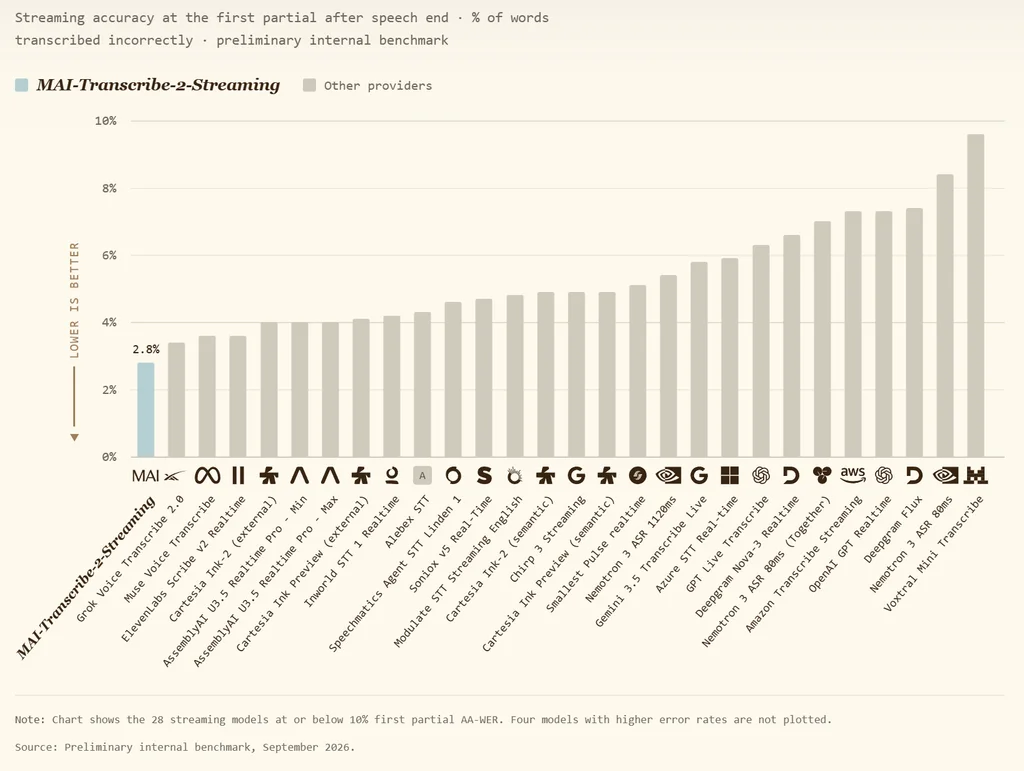
MAI-Transcribe-2-Streaming doesn’t wait for a speaker to finish before producing text. It detects language automatically and returns initial transcription hypotheses, known as partials, within what Microsoft describes as the “low hundreds of milliseconds” after audio arrives. As more speech provides context, the model revises those hypotheses and then settles on a final transcript when the utterance ends.
That design lets an application begin work while the user is still talking. A customer service system could start classifying a caller’s request before hearing the full sentence. An assistant could begin reasoning or prepare a tool call while the speaker continues. For live captions, words can appear close to the moment they’re spoken.
“A live transcription experience can surface words almost as quickly as they are spoken.”
Moneypenny says MAI-Transcribe-2-Streaming debuts at number one for accuracy on both partial and final transcripts in the Artificial Analysis benchmark leaderboard. That ranking is Microsoft’s reported result; the operational value will depend on how well early hypotheses hold up in the settings where developers deploy the model.
Two voice models serve different priorities
Microsoft positions MAI-Voice-2.1 as the choice when developers care most about expressive fidelity. The Flash variant is aimed at live support agents, voice assistants and other applications that need to generate speech quickly while balancing naturalness, responsiveness and cost at scale. Together with streaming transcription, the models cover both ends of a voice agent’s audio pipeline: hearing a user and speaking back.
Microsoft’s pitch points toward customer service, multilingual assistants that recognize a spoken language and answer in a consistent voice, interactive learning exercises that move between languages and speakers, live captions, and voice-driven interfaces. The models provide building blocks for those products. Their presence doesn’t, by itself, determine whether an agent can handle a real conversation reliably.
Fast speech APIs changed the infrastructure equation
Will Bodewes, CEO of voice-agent platform Phonely, sees Microsoft’s move as evidence that voice AI is ready for broader use. Microsoft has worked in speech for years through Azure Speech, and these MAI models extend that experience into its Foundry catalog. Bodewes expects other providers to follow, while emphasizing that a strong speech model is only one part of a production system.
He recalls that early hosted speech APIs could leave a request waiting behind a thousand others for 30 seconds. On a phone call, that kind of delay can prompt a caller to hang up. Phonely built routing infrastructure to direct requests to less-loaded endpoints, and Bodewes says owning its model and queue helped the company reach 120-millisecond responses.
His account also highlights a design choice beyond raw model speed: put required business steps in code. If an agent needs a caller’s name, email address and date of birth before issuing a refund, Bodewes argues, the application should enforce those requirements instead of relying on a prompt to make the model follow them consistently. The system’s workflow and safeguards matter as much as its spoken interface.
Turn-taking is the next latency problem
Phonely machine learning researcher Amit Kiran Rege agrees that Microsoft is addressing useful parts of the pipeline, but points to a difficult interaction problem between listening and responding: deciding whether a caller has finished or is simply pausing to breathe.
In Phonely’s experience scaling voice agents to millions of calls, a faster data pipeline sometimes caused agents to start speaking too early. Rege says that in two-thirds of cases where the agent decided to jump in prematurely, the reply was canceled because the caller resumed before its first syllable. With lower latency, those canceled replies can become audible interruptions.
That’s the tradeoff behind “instant” voice interaction. A system must reduce the time it takes to understand and answer, while also giving the speaker enough room to continue. Rege’s warning is that latency and turn-taking need to improve together; shaving milliseconds off transcription or speech generation can expose errors in conversation timing that slower systems concealed.
For developers, Microsoft’s release makes it easier to build around streaming input and responsive speech output inside Foundry. The next measure of progress will be whether agents can combine those capabilities with dependable workflows and natural pauses. In a phone conversation, speed matters most when the system also knows when to listen.


