Watch size is usually treated as a style choice. For people who rely on a smartwatch to track workouts, it can affect the data, too. A loose fit lets light reach the optical sensor and can throw off heart-rate readings, so the smallest size that sits securely may be the better tool. The catch: a larger watch can be easier to read and leave more room for a battery and other hardware.
We may earn a commission from links on this page.
Fit can change what your watch reports
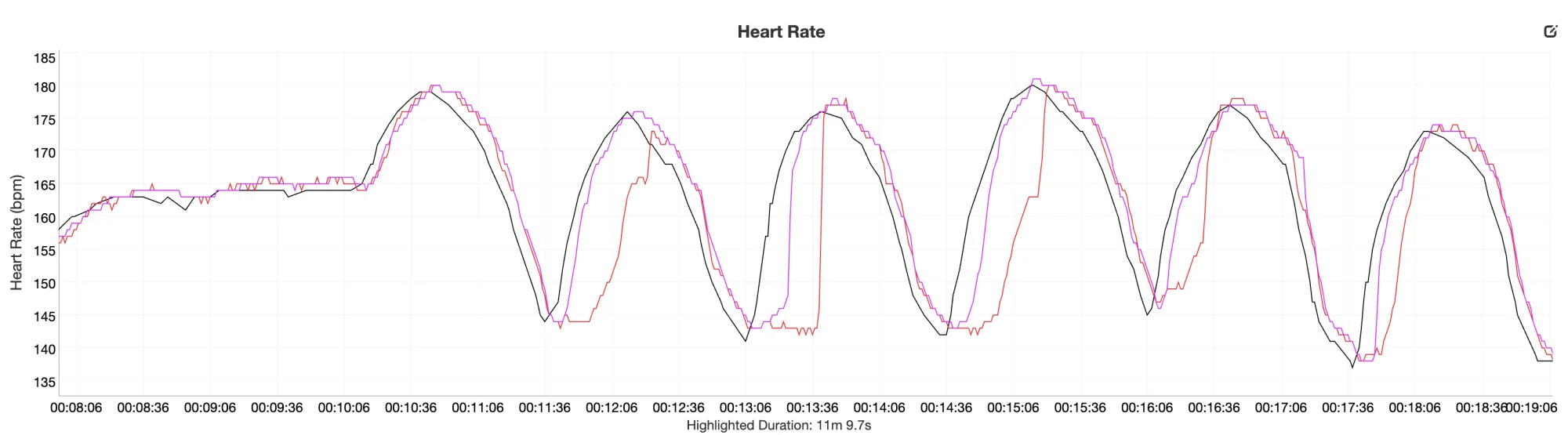
Garmin Forerunner 265 (larger) in red, 265s (smaller) in pink. Chest strap for reference in black.
Credit: Beth Skwarecki
The green light on the back of a smartwatch is part of its optical heart-rate sensor. It reads changes in light reflected by blood vessels near the skin, which means the sensor needs steady skin contact and a snug seal that keeps outside light out. If the watch shifts or ambient light leaks underneath, the reading can drift.
During a run, a watch that bounces with each step may mistake those flashes of light for a pulse. The result can be “cadence lock”: a heart-rate trace that tracks footsteps per minute instead of your actual heart rate. Pulling a sleeve over the watch can help limit light in some conditions, but fit is still doing much of the work.
Here’s the thing: a watch that’s too large for your wrist has more trouble staying put. Very small devices can struggle too if they can’t be tightened enough to block light. That may help explain why smart rings often do poorly at daytime heart-rate tracking.
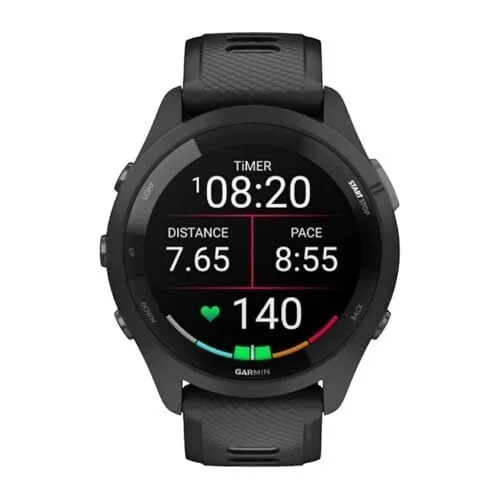
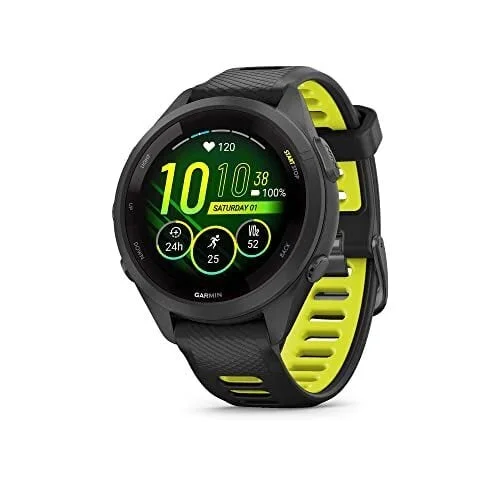
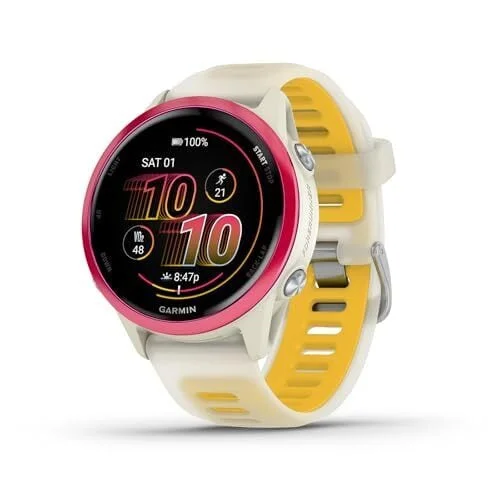
I wanted to see whether the fit issue showed up outside theory, so I ran with the Garmin Forerunner 265 and 265S at the same time. They share a heart-rate sensor and differ in size. In my comparison, the 42 mm 265S tracked my heart rate more accurately than the 46 mm 265. The full results are here.
Why bigger still has its place
If accurate heart-rate tracking were the only goal, I’d pick the smallest watch that fits securely. Small wristwatches were common long before smartwatches; look at older films and you’ll see tiny cases on all kinds of wrists.
But a bigger display has a practical payoff: text, numbers, and icons are easier to read at a glance, whether your eyesight has changed or you’re checking the screen mid-workout. More space can also mean a larger battery and room for additional components. That may explain why premium models often come in larger cases, though it’s hard to tell where hardware needs end and a higher price tag begins.
Smaller options shouldn’t be an afterthought
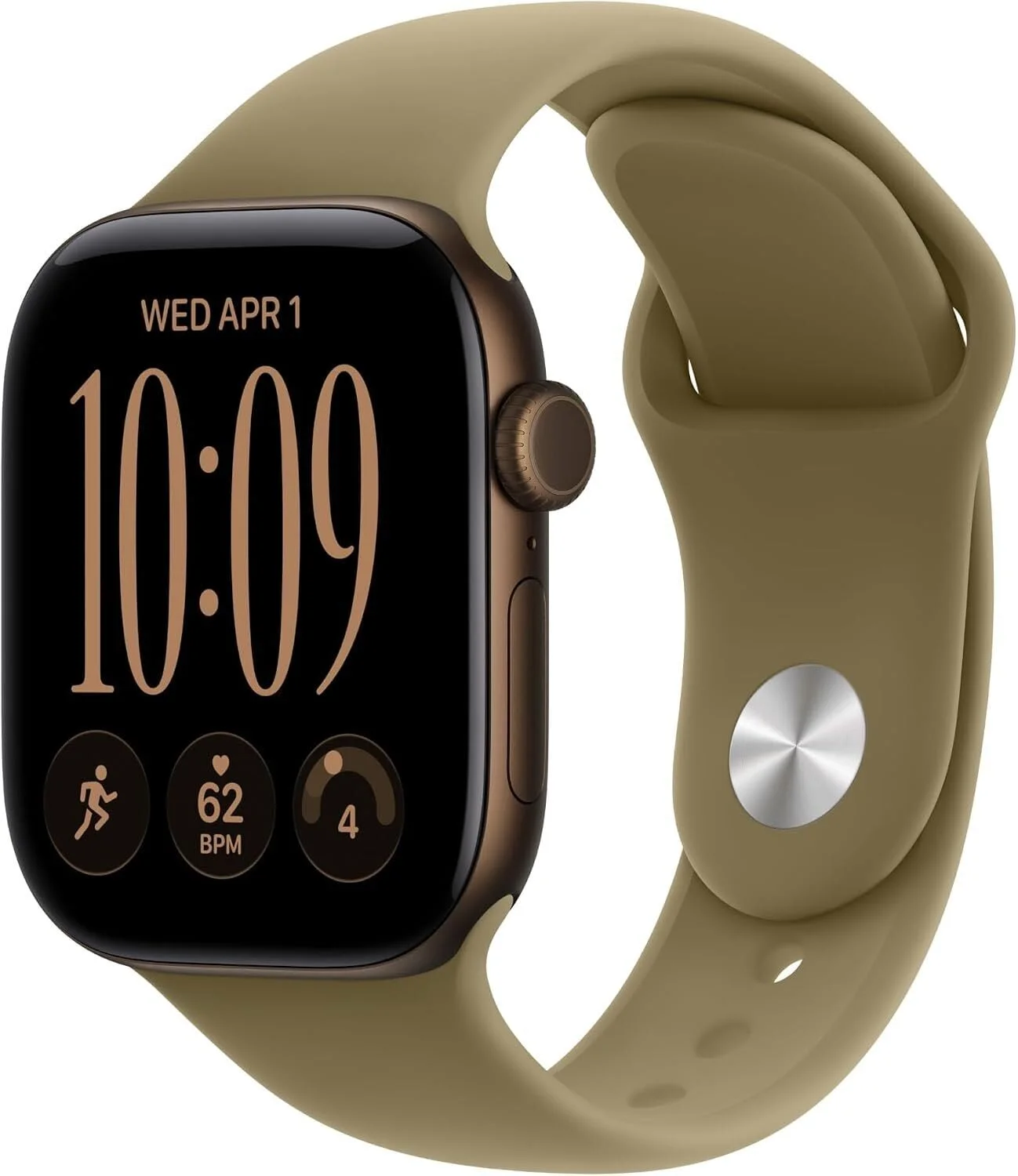
Companies already acknowledge that case size matters by offering multiple sizes on some watches. The Apple Watch Series 12 is available in 42 mm and 46 mm versions; Garmin’s Forerunner 570 comes in 42 mm and 47 mm sizes. Those choices are useful, but they also underline the gap: people with smaller wrists shouldn’t have to choose between a comfortable fit and access to a full featured watch.
Premium watches still favor larger wrists
The size problem gets harder to ignore at the top of the market. Garmin’s
Forerunner 970 is
more feature-rich than the 570, but comes only in a 47 mm case. The
Apple Watch Ultra 4 is available only at 49 mm, larger still than the bigger Series 12. I’m about to test a Hyrox feature that’s limited to Amazfit’s Balance 3 and Balance Ultra, which measure 51 and 52 mm. At some point, “premium” starts to look like a synonym for “oversized.”
That pattern has a real effect on who can use these devices comfortably. The
ANSUR II U.S. Army study puts women’s average wrist circumference at 154 mm, or about 6.1 inches, compared with 176 mm (about 6.9 inches) for men. My wrist is roughly six inches, close to the women’s average.
When brands sell two case sizes, the smaller one often fits an average woman’s wrist better, while the larger one tends to suit an average man’s. Those are broad averages, of course; people’s wrists and preferences vary. Calling the options “small” and “large,” or listing their measurements, is sensible. The trouble starts when smaller sizes disappear from the most capable models.
A watch that doesn’t sit securely can bounce, rub, and collect less reliable sensor readings. I’m not unusually small; I’m close to average for women. Yet larger watches are harder for me to wear accurately than they are likely to be for an average man. I saw a similar fit problem with the
Powerbeats Pro 2 heart rate tracking: it barely worked for me, then performed fine on a man with larger ears.
There’s a pricing wrinkle, too. Garmin sells the 970 only at 47 mm, while its less expensive Forerunner 70 and 170 are available at 43 mm. The
Venu 4 comes in 41 and 45 mm sizes, but the cheaper
Vivoactive 6 is offered only at 42 mm. A smaller wrist may save you money on some models, but it can also leave you without access to premium features.
How to tell if a watch is too large
After testing watches from around 40 mm—an older Apple Watch—to 48 mm, including the
Kospet Tank and
Amazfit T-Rex 3 Pro, I know where I’m comfortable: 40 to 42 mm feels best. I can manage about 46 mm if the watch is light enough to stay put. Bigger than that, and fit becomes a problem.
For exercise, a heavy watch has to be tight enough to stop bouncing. Tighten it too far and it can feel like it’s cutting off circulation; on long runs, friction has left my wrist red and irritated. The box won’t tell you how a watch will behave on your arm, but a quick visual check helps: put it on, rest your arm on a table, and look down at your wrist. If the lugs—the ends of the watch case—extend past your wrist, the watch is too wide for that fit. It should sit on your wrist, not hang over its edges.
If a larger case suits you better for readable text or maps, or it’s the only size with a feature you want, you can still improve heart rate readings during exercise. Pair the watch with a
chest strap, if it supports one, or connect the strap to your phone. That can be a practical compromise: keep the display or feature you prefer, while getting heart rate data from a sensor that fits more reliably.