Selecting Optimal Agentic Design Patterns with a Decision-Tree Methodology
May 13, 2026
908 views
Introduction
When developers embark on creating AI systems, the first hurdle often arises from a misunderstanding of the task at hand. Choosing the right design pattern isn't just a technical choice; it's foundational to the entire system's performance. Too frequently, developers lean towards patterns that appear impressive or familiar, neglecting the actual requirements of their specific tasks. The classic pitfall is constructing a complex multi-agent system for problems that could easily be solved with a single, well-designed agent. Conversely, some take a minimalist approach and run into scalability issues only after deployment, leading to rushed redesigns that can be costly. The selection of a design pattern is where significant design insight is applied. Although agentic design patterns are well-explained in various resources, what remains less articulated is the underlying reasoning for choosing one over another. This article tackles that reasoning by introducing a decision tree approach designed to guide developers through the selection process. Instead of arriving at a singular conclusion, this decision tree helps clarify the initial steps based on task requirements, constraints, and acceptable trade-offs. As AI architectures grow and adapt, this reasoning framework provides a solid foundation from which to revisit decisions when new information arises.The Importance of Choosing the Right Agentic Design Pattern
Before diving into the decision tree, it’s essential to grasp why the choice of a design pattern carries weight. Each agentic design pattern is grounded in specific preconceptions about task structures and their demands. For instance: - The **ReAct pattern** operates on the premise that outcomes cannot always be predicted in advance, thus combining reasoning and tool usage to enhance decision-making. - The **Planning pattern** assumes that the overall task structure can be identified ahead of time, which can enhance reliability through a well-defined execution roadmap. - The **Reflection pattern** anticipates that initial outputs may be flawed, advocating for iterative self-evaluation to enhance quality. - Multi-agent systems thrive on the belief that distributing tasks across specialized roles offers advantages that outweigh the need for coordination. When the underlying assumptions resonate with the task’s nature, that pattern can significantly enhance efficiency and outcomes. Conversely, misalignments introduce unnecessary complexities that can stifle performance. For example, employing planning for tasks that only clarify as they evolve can lead to rigidity, while a reflection pattern applied to straightforward tasks may result in wasted resources. To assist in thoughtful design pattern selection, the following decision tree will guide you through the fundamental properties of your task, ensuring you choose a pattern that aligns with your specific needs.A Decision Tree for Effective Agentic Design Pattern Selection
This decision tree presents five critical questions, each designed to help narrow down potential design patterns based on task characteristics.Question 1: Can You Define the Solution Path in Advance?
The first question distinguishes between known workflows and those that require adaptability. - A **known solution path** allows you to outline every step before implementation. For example, consider invoice processing: extract data, validate, store, and confirm. Similarly, tasks like employee onboarding follow predictable sequences. - On the other hand, an **unknown solution path** signifies that each step is contingent on the results of the last one. Research tasks, customer support inquiries, or debugging processes cannot be pre-specified. If your solution path is known, proceed to **Question 2a**. If it remains unknown, move on to **Question 2b**.Question 2a: Is the Workflow Fixed?
For recognized and stable processes, consider employing a **sequential workflow pattern**. It prescribes following explicit steps in a defined order until the task is completed. The critical design choice revolves around where reasoning should be integrated. Typically, you would reserve reasoning for tasks involving interpretation or generation, while simple, deterministic code can efficiently handle the rest. The focus here is maintaining speed and predictability, preventing unnecessary complication. Over-engineering is a common pitfall, especially when developers mistakenly incorporate complex reasoning methods into straightforward processes. If your fixed workflow encounters complications or needs unanticipated steps, then shift to **Question 2b**.Question 2b: Is External Tool Access Required?
For tasks with **unknown solution paths**, the next inquiry examines whether the agent needs to fetch data from external sources—be it querying a database, dialing an API, or retrieving documents—or can it rely solely on its existing context? The reality is that external interaction is often necessary. An agent limited to its training data or existing conversation context severely restricts its applicability to real-world scenarios. Once external information or actions enter the equation, tool usage becomes crucial. Proper tool design—with clear expectations for input and output—enhances capability without altering the core reasoning model. A ReAct agent employing tools remains fundamentally ReAct, while a planning agent keeps its planning identity when interfacing with tools. You can assume that tool use is required as you move to **Question 3**, unless the task is genuinely self-sufficient.Question 3: Is Task Structure Clear Prior to Execution?
This question differentiates between the **Planning** and **ReAct patterns**. Many developers skip this critical evaluation, defaulting to ReAct out of convenience. The ReAct approach dynamically alternates between reasoning and action until it meets a defined endpoint. However, a task is **structurally articulable** when it can be segmented into clear subtasks with identifiable dependencies from the outset. This clarity might not encompass every minute detail, but the overall structure should be evident. For instance, orchestrating software features or crafting a detailed report all follow a natural order. The **planning pattern** is beneficial under these circumstances as it safeguards against unexpected surprises and inefficiencies. Note, however, that planning requires an upfront commitment, which could be a hindrance if real-world variables shift substantially. If the task structure is clear, then opt for **Planning with integrated ReAct steps**. If the structure becomes clearer through hands-on involvement and feedback, utilize **ReAct** and proceed to **Question 4**.Question 4: Does the Quality of Output Matter More Than Speed?
At this juncture, we introduce the **reflection pattern**—a process incorporating generation, critique, and refinement—to ascertain if it should accompany your chosen pattern. Reflection becomes significant when two conditions exist: 1. The output can be evaluated against **specific quality standards** (like producing valid documents or well-supported arguments). 2. The **consequences of errors** are severe enough to warrant additional processes (think of deployment scenarios where the cost of mistakes could be high). When these criteria are absent, reflection may yield vague or misleading evaluations. In environments where speed is of the essence, like high-stakes applications, reflection has the potential to introduce slowdowns that are inadvisable. Crucial to reflection’s effectiveness is the independence of the critique mechanism. A critic that too closely resembles the original generator tends to yield agreeable, rather than genuinely evaluative feedback. If maintaining high quality is paramount and the criteria for evaluation are lucid, incorporate **Reflection**. Otherwise, prioritize speed and advance to **Question 5**.Question 5: Is There a Scale or Specialization Challenge That a Single Agent Can't Address?
Here, you need to assess whether a **multi-agent architecture** is necessary. This choice should only emerge after careful consideration of the previous criteria. **Multi-agent systems** shine when tasks exceed the limits of a single agent’s capabilities, necessitate different expertise, or allow for parallel execution, thus optimizing time. They effectively distribute responsibilities among specialized agents, yet they also introduce complexities associated with synchronization, shared state, and additional potential points of failure. Specialization difficulties arise when various stages of a task demand distinct reasoning approaches. Scale challenges manifest when the workload exceeds one agent's capacity or invites unnecessary serialization. If neither of these dilemmas applies, a single competent agent typically suffices. The catalyst for considering a multi-agent structure should be an identified bottleneck that a multi-pronged strategy can resolve, rather than a simplistic preference for complexity. In sum, the decision tree outlined here culminates in a mapping of agentic design patterns based on your system’s nuanced requirements. By engaging with each question, you’ll be armed with a clearer understanding of the best path forward, ensuring that your system achieves its intended goals efficiently.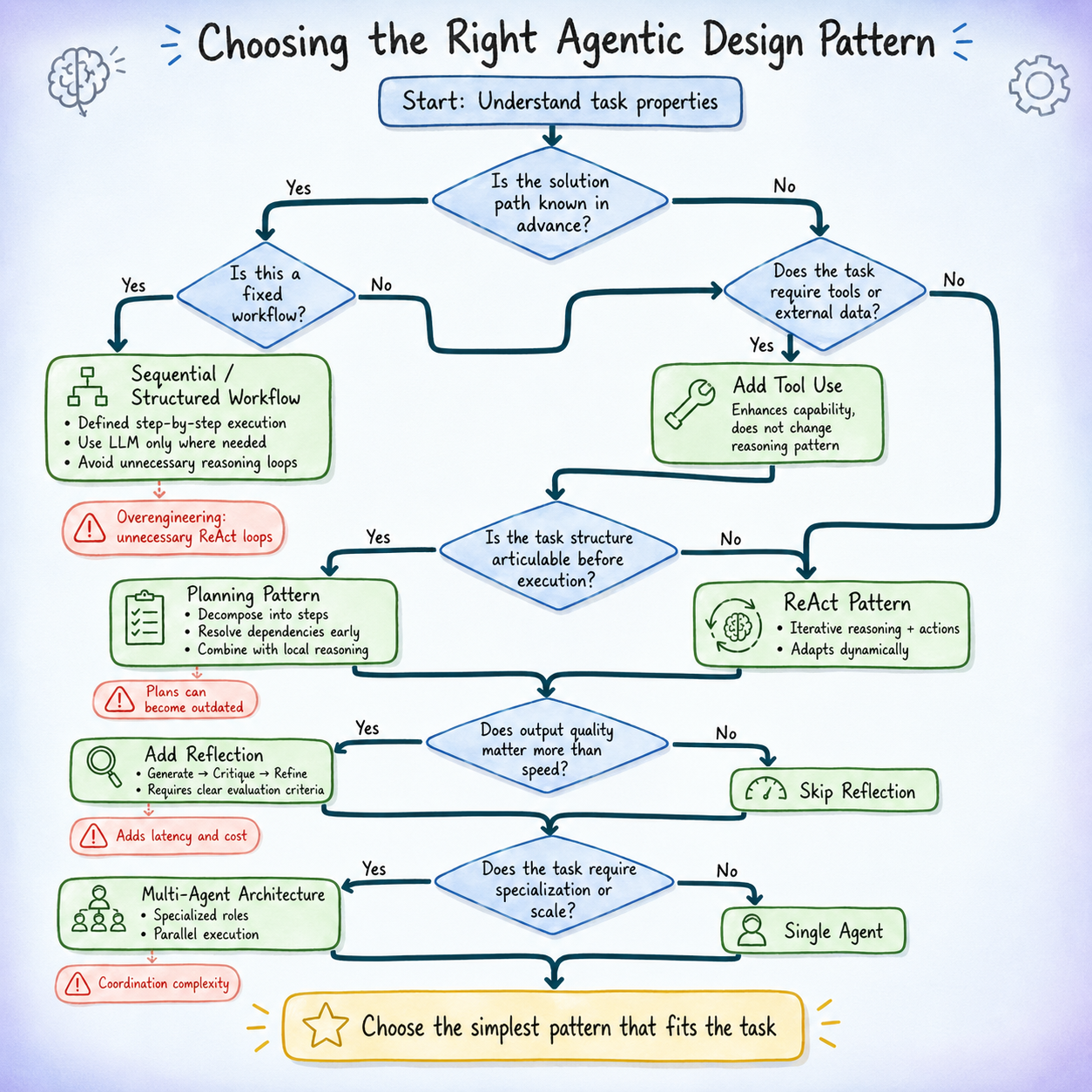
Decision Tree for Choosing the Right Agentic Design Pattern