The Impact of AI on Developer Skills: A New Generation Lacks Debugging Proficiency
The rise of AI-assisted programming tools has fundamentally shifted the landscape of software engineering, particularly affecting how junior developers navigate their roles. While these tools have seemingly enhanced productivity—allowing juniors to complete coding tasks significantly faster—they also mask a perilous oversight gap in the understanding and comprehension of the code itself. This dual-edged sword poses serious challenges that the industry must address as we move toward an AI-centric future.
The Paradox of Productivity
Recent data from Octopus Deploy reveals that junior engineers can accomplish tasks up to 55% quicker with AI assistance. Yet this remarkable leap in efficiency raises a crucial question: does speed equate to competence? The reality is unsettling. As AI tools proliferate, they enable juniors to produce clean code that passes review, but many lack the deeper understanding required to explain their work or troubleshoot effectively. In fact, a significant 73% of organizations have reported reducing their junior hiring in the last two years, as companies opt for a "seniors with AI" model that emphasizes experienced developers supplemented by AI capabilities.
The productivity numbers everyone quotes are real. They are also misleading.
This situation plays out in code reviews, where juniors’ lack of experience limits their ability to critically evaluate AI-generated solutions. While they may produce the required outputs efficiently, they often miss the nuances that seasoned developers instinctively recognize based on their deep architectural understanding. This gap highlights an urgent need for mentorship, as the mentors who would traditionally guide juniors through these learning processes may themselves be lagging in AI competence.
A New Breed of “Expert Beginner”
Erik Dietrich’s concept of the “expert beginner” describes developers who plateau early, advancing to positions of responsibility without a corresponding depth of knowledge. This contemporary version isn’t characterized by arrogance; rather, these juniors are industrious and conscientious yet fail to grasp the fundamental 'why' behind the code they ship. They function well within the frameworks of AI-assisted coding yet lack an innate understanding of the systems they are contributing to.
Ivan Krnic, a Director of Engineering at CROZ, emphasizes that while juniors bring an open-minded approach, this very trait can hinder their ability to validate AI outputs. The reliance on AI for code generation brings a critical imbalance; productivity surges without a corresponding growth in conceptual comprehension.
The Shifting Talent Pipeline
The state of entry-level tech roles paints a stark picture of the industry’s looming crisis. A report from the Stanford Digital Economy Lab indicates a staggering 67% decline in U.S. entry-level tech job postings between 2023 and 2024, with similar trends evident in the UK. This substantial contraction suggests a restructuring of hiring practices that increasingly prioritizes AI technology at the expense of nurturing new talent.
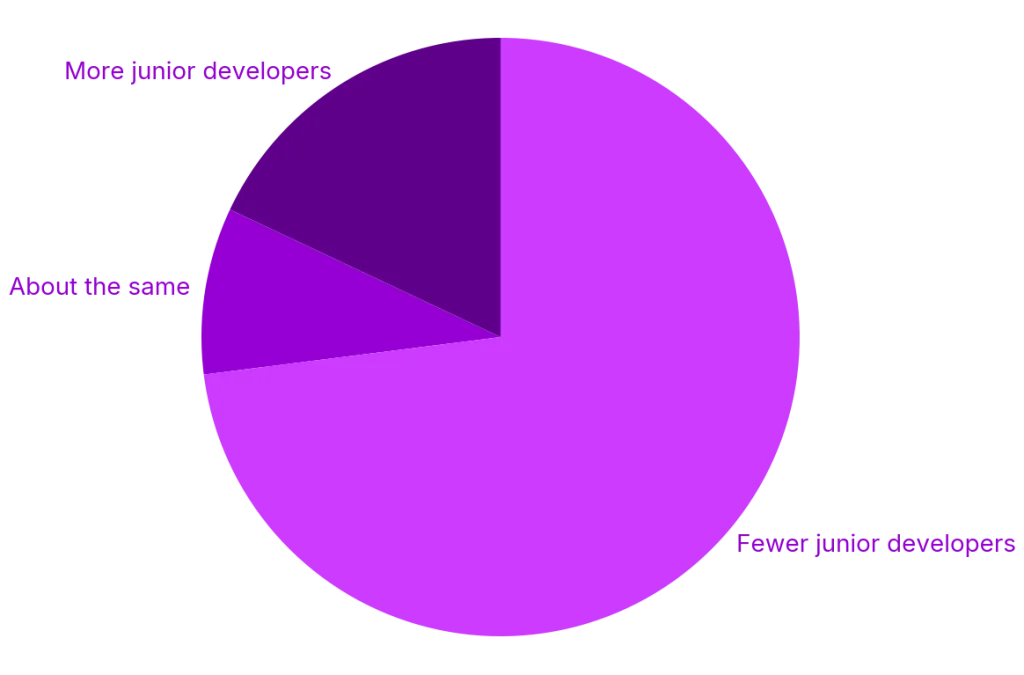
Junior developer hiring has decreased over the past two years, according to Octopus Deploy’s AI Pulse report.
What’s alarming is that over half of entry-level job postings now require prior experience, limiting opportunities for fresh talent. As internships plummet—down 30% since 2023—there's a clear trend toward organizations investing in AI at the expense of training and mentoring novice developers. It raises significant concerns about the future competency of the tech workforce.
The Cycle of Talent Development
This contraction in junior roles is not an isolated phenomenon; it's part of a cyclical pattern familiar to industry veterans. Previous downturns, such as the dot-com bust and the aftermath of the pandemic, witnessed similar trends where junior intake diminished, leading to skill gaps among more senior staff down the line. However, the current crisis is compounded by the nature of AI’s role in software development.
While today’s juniors are getting their tasks done, those repetitions may not be developing the same instincts that come from working through hard problems.
AI’s ability to simplify complex tasks erodes the experiential learning that typically arises from grappling with programming challenges. This lack of hands-on problem-solving could result in a generation of engineers who may swiftly write code but lack the analytical tools to debug or understand it when things go awry.
Questions for the Future
As the industry grapples with these developments, organizations must introspectively evaluate the capabilities of their junior hires. Can they accurately explain the code they produce? Are they equipped to identify bugs without relying on AI support? If the answer to either question is no, it signals a deeper issue rooted in the structure of the engineering pipeline.
The implications are profound: as AI tools become more embedded in daily workflows, the gap between coding proficiency and conceptual understanding widens. Without strategic interventions—emphasizing mentorship and hands-on coding experience—the workforce risks stagnation, creating a cycle that perpetuates reliance on technology without true understanding. For teams that rely heavily on junior developers, this evolution poses an imminent threat to competence and operational integrity, demanding urgent attention to rebalancing training and hands-on learning in this changing landscape.