Gemini 4 Hydrogen Trades Flash Branding for Faster, More Reliable Agent Work
Google has dropped the "Flash" label. Gemini 4 Hydrogen arrives right after Carbon became available earlier this week, and Google positions it as a "major standalone upgrade" over Gemini 3.8 Flash, which launched in September. My read: the real gains are in speed and in how the model behaves when tools fail, not in chat polish.
Speed and error handling
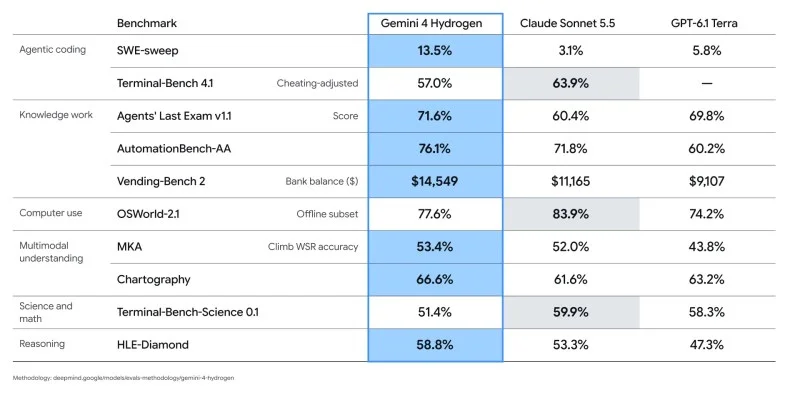
Google says Hydrogen finishes "tasks 2.5 times faster at its high default setting." On Terminal-Bench 4.1, it scores 57% against 18.2% for its predecessor, more than tripling the result. It supports native 1 million-token input and up to 1 million output tokens.
The claim that deserves more attention is about mistakes. Google says Hydrogen cuts "fabricated claims by more than 5x" and adapts "cleanly when a tool call fails or a search returns empty." Anyone who has watched an agent confidently invent a source knows that matters more than a leaderboard spot.
Where it lands on benchmarks
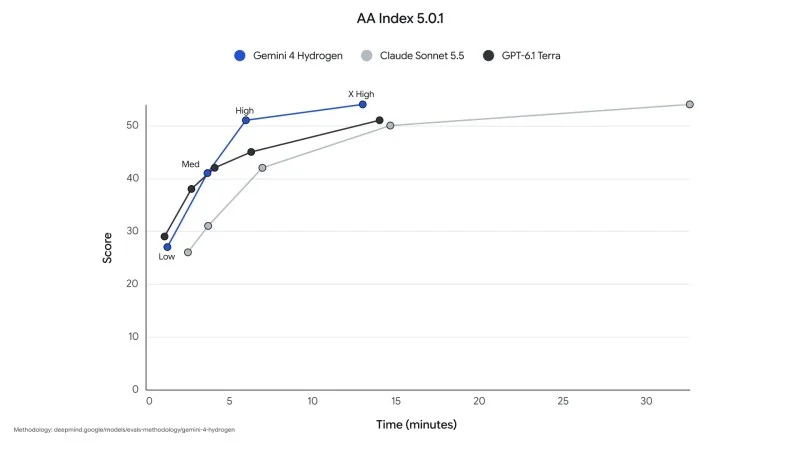
On the Artificial Analysis Intelligence Index, Hydrogen scores 51 at its default high thinking level, ahead of Argon's 50. It reaches 54 at its highest xhigh setting. Google's partners report Hydrogen running 2x to 2.8x faster than 3.8 Flash, with token usage down 12% to 23%.
Google's agent-focused results:
- Ranks #5 on Agent Arena for multi-step work like deep research, data analysis, and broad codebase navigation
- Leads its class on HLE-Diamond at 58.8%
- Ranks #1 overall on Vals Tax Agent Bench at 52.3%
- Ties for #1 on the Vals Legal Research Bench at 55.8%
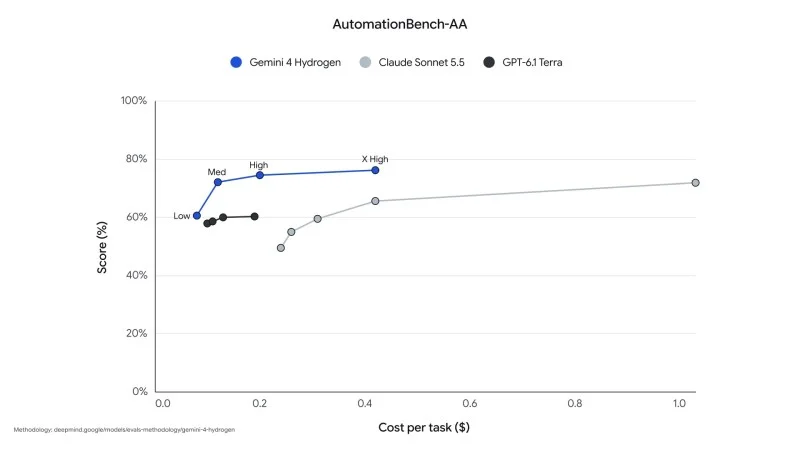
- Leads its class on AutomationBench-AA
- Scores 53.4% on the new Multimodal Knowledge Agent (MKA) benchmark, which tests agentic work over complex visual files
- Scores 71.6% on Agents' Last Exam v1.1 for end-to-end professional workflows
The safety numbers are where I'd look closely. Compared with 3.8 Flash, Google says Hydrogen reduces overreach in agentic tasks by up to 81% and under-service by up to 79%. It cuts misaligned actions and task shortcutting across tool-use and coding evaluations by 12x. When a task is impossible or blocked, it's up to 2x less likely to bypass permission boundaries. On Google's internal agent honesty evaluation, it reaches a 96.7% honesty rate.
Gemini app and Search
In the Gemini app, Hydrogen sticks to the tone, format, and rules you set, and it produces clear tables and visual breakdowns. Google says email drafts, study guides, rewrites, and documents "come back ready to use on the first try." It also calls the right tools and skills, including Connected Apps, more often.
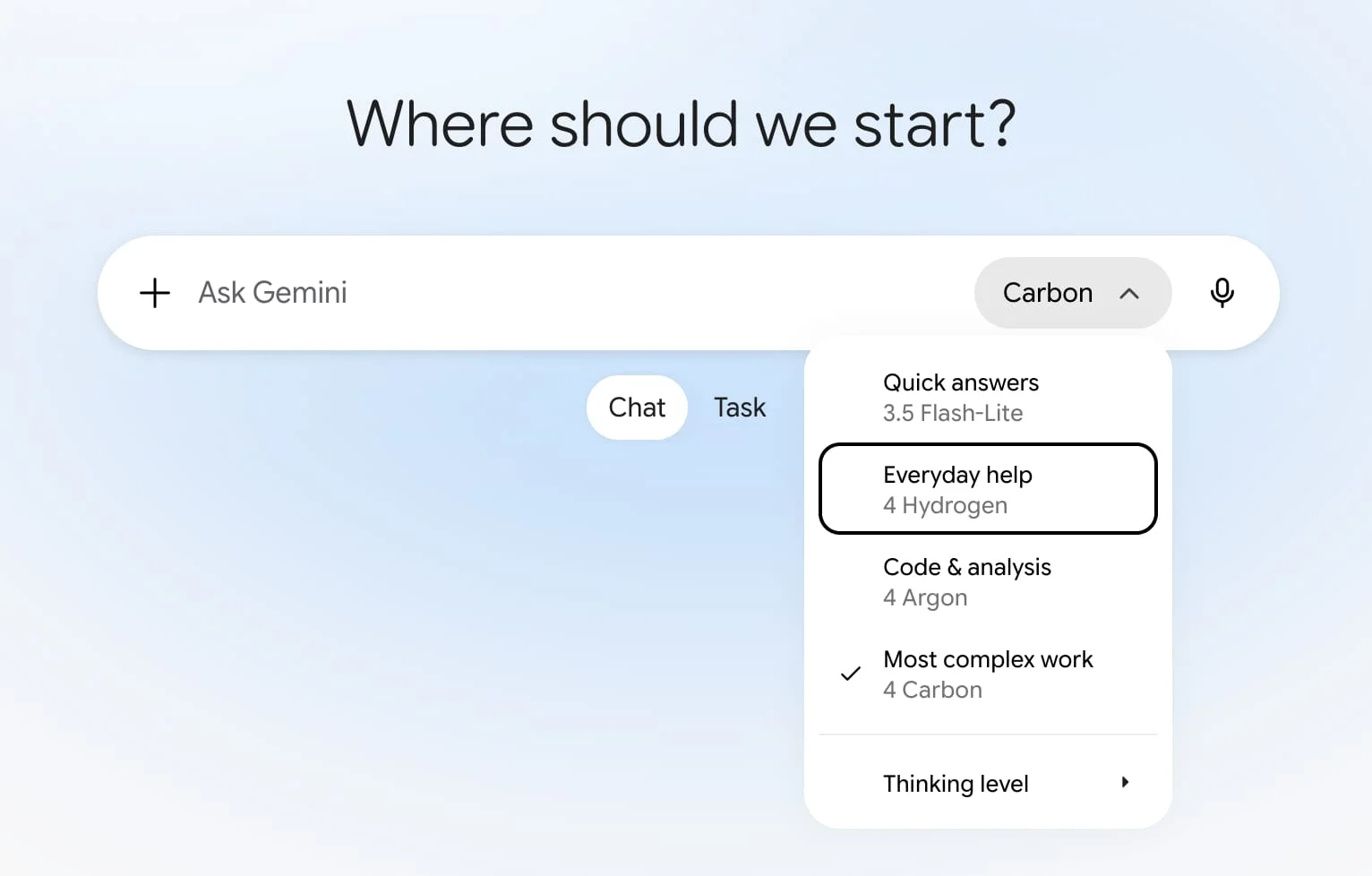
The model picker now reads like a menu of jobs:
- Quick answers: 3.5 Flash-Lite
- Everyday help: 4 Hydrogen
- Detailed research: 3.1 Pro (on AI Pro)
- Code & analysis: 4 Argon
- Most complex work: 4 Carbon
Free users reach Hydrogen through Auto model selection, which picks it when it fits the prompt.
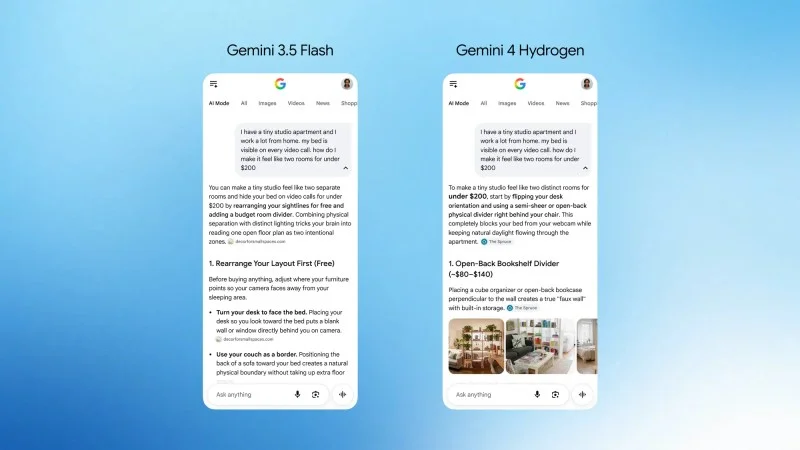
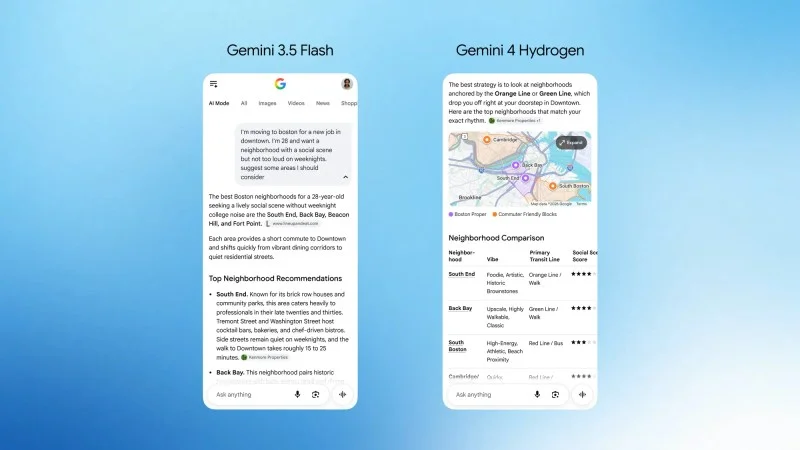
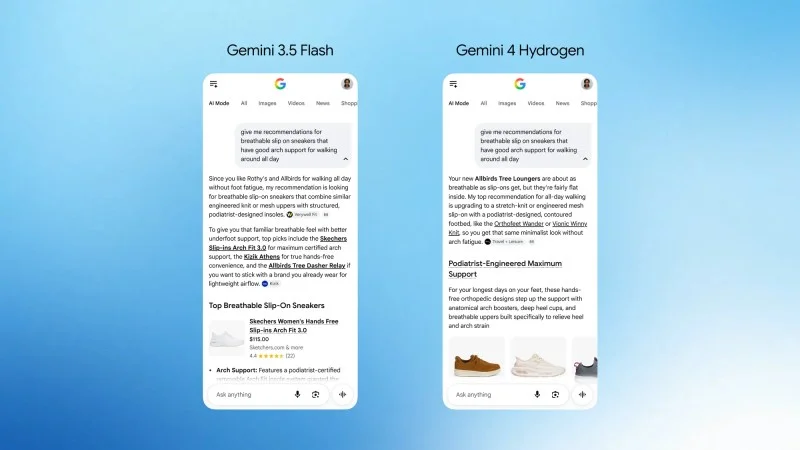
Search is the bigger deployment. Hydrogen is the default model for AI Mode and handles "your hardest questions" in AI Overviews. Google says the model handles multi-part queries, hard-to-read typos, and highly specific requests, and it returns more visual responses with a wider range of relevant links.
Antigravity and multi-model sessions
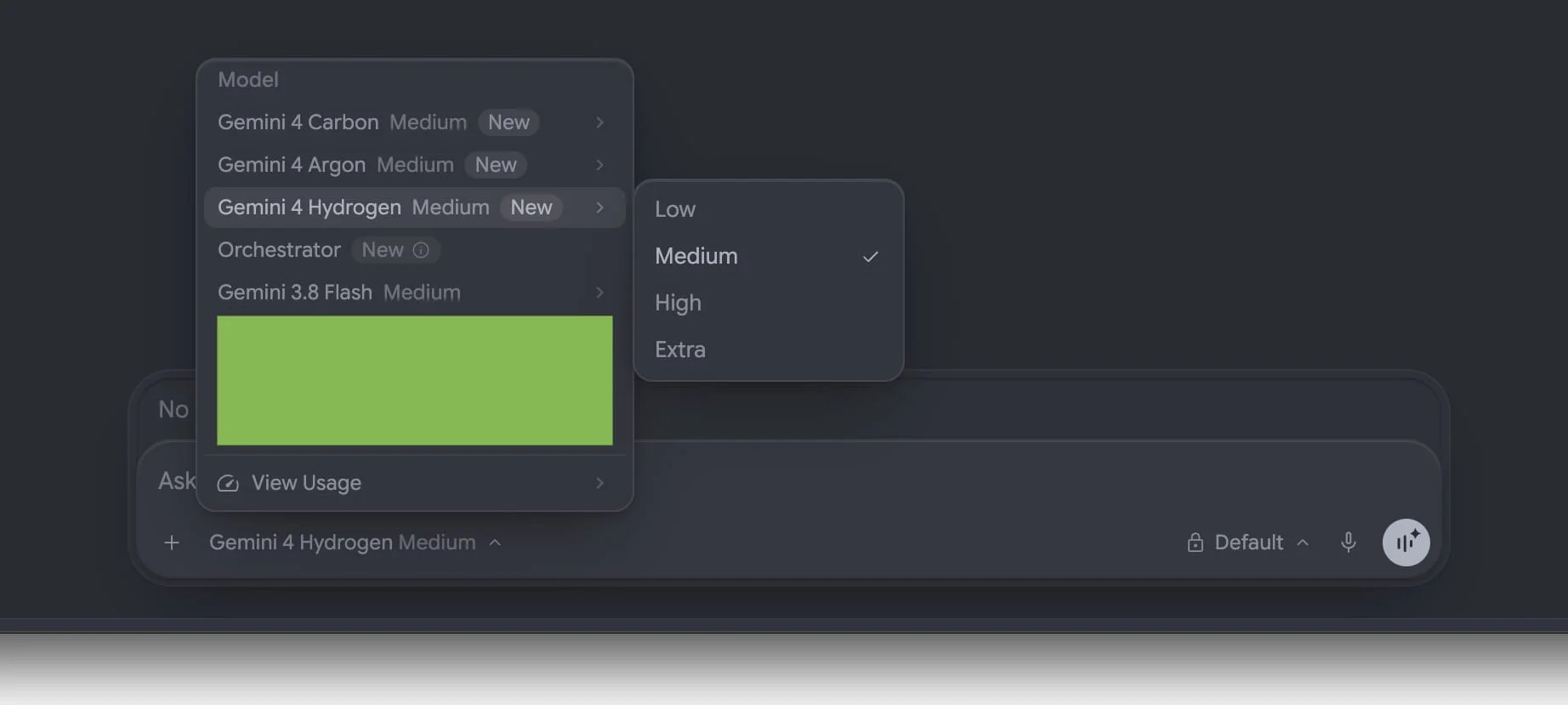
For developers, the more interesting change is in Google Antigravity. Hydrogen adds an "Extra" thinking tier next to Low, Medium, and High. Then there's Orchestrator, which lets a session move between models instead of locking into one.
Orchestrator can hand routine steps from Carbon to Hydrogen, keeping Carbon-level quality while using fewer tokens. Google describes a setup where Carbon coordinates while Hydrogen runs worker and verifier agents that build and test changes in parallel across isolated workspaces.
Hydrogen is available in Antigravity for paid Google AI Pro and Ultra subscribers. For developers using the API, pricing is $1.50 per million input tokens and $7.50 per million output tokens.
That price is the number to watch. At those rates, Hydrogen is cheap enough to serve as the worker in a multi-agent loop, and that orchestration pattern may end up mattering more than any single benchmark score.