How Often AI Search Engines Recommend Webflow for CMS and MCP Integration

AI answers can put a product in front of developers before they ever reach its website. That makes a recommendation worth tracking, even when it’s hard to connect it to a sale. Webflow’s early numbers show why the distinction between being mentioned and being described accurately matters.
We tested Claude with the question, “Which CMS platforms support MCP integration?” In one answer, Claude placed Webflow sixth among headless and SaaS CMS platforms with hosted MCP servers. Its description said the server manages sites through the Data API, including pages, components, CMS collections and items, assets, forms, and publishing.
Which CMS platforms support MCP integration?
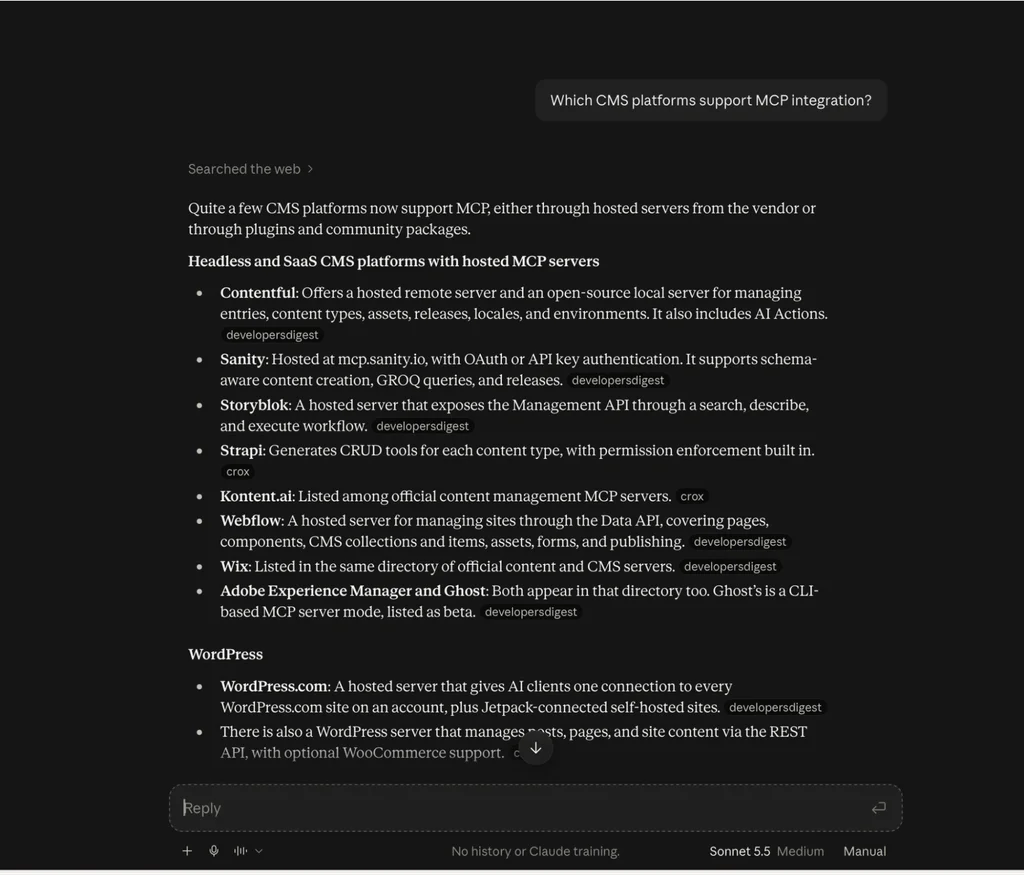
That answer was the most detailed of four manual runs, so it shouldn’t stand in for a typical result. Webflow appeared as its own bullet in three runs: two mentioned CMS collections and items, while one referred only to the Data API and Designer. In the remaining answer, Webflow shared a bullet with another platform and got no description.
The reason to care is straightforward: nearly 70% of respondents to Stack Overflow’s 2026 developer survey said they use an AI agent to find answers. We wanted to see what those agents recommend when developers ask which product to choose.
AI answers can shape the shortlist
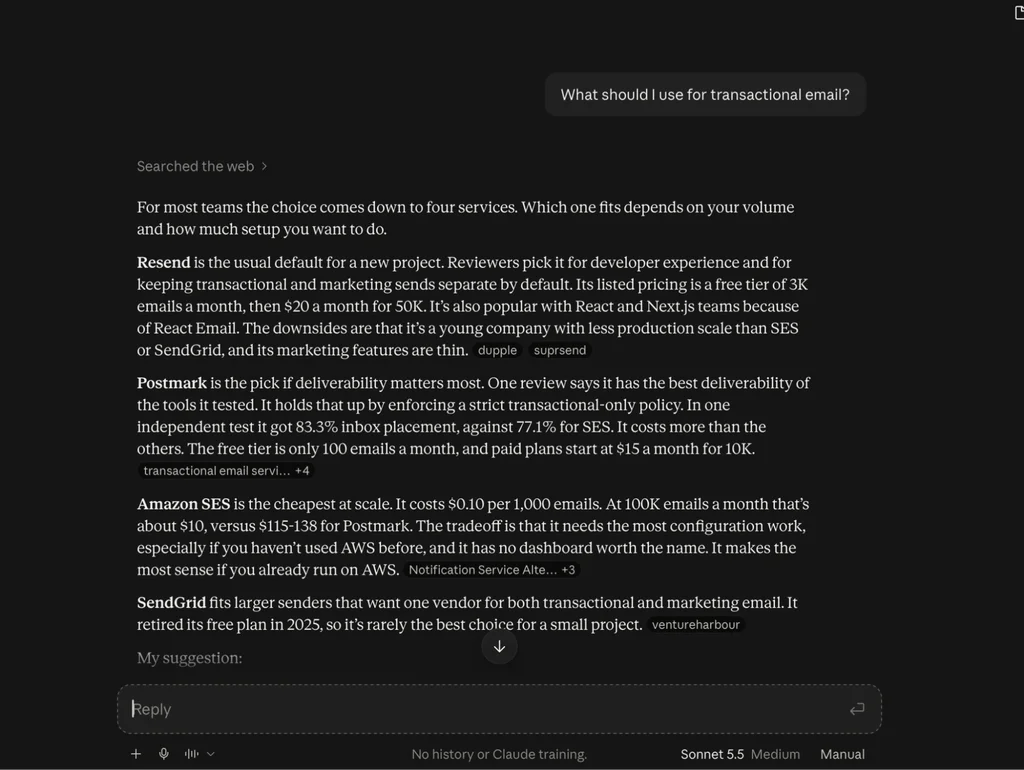
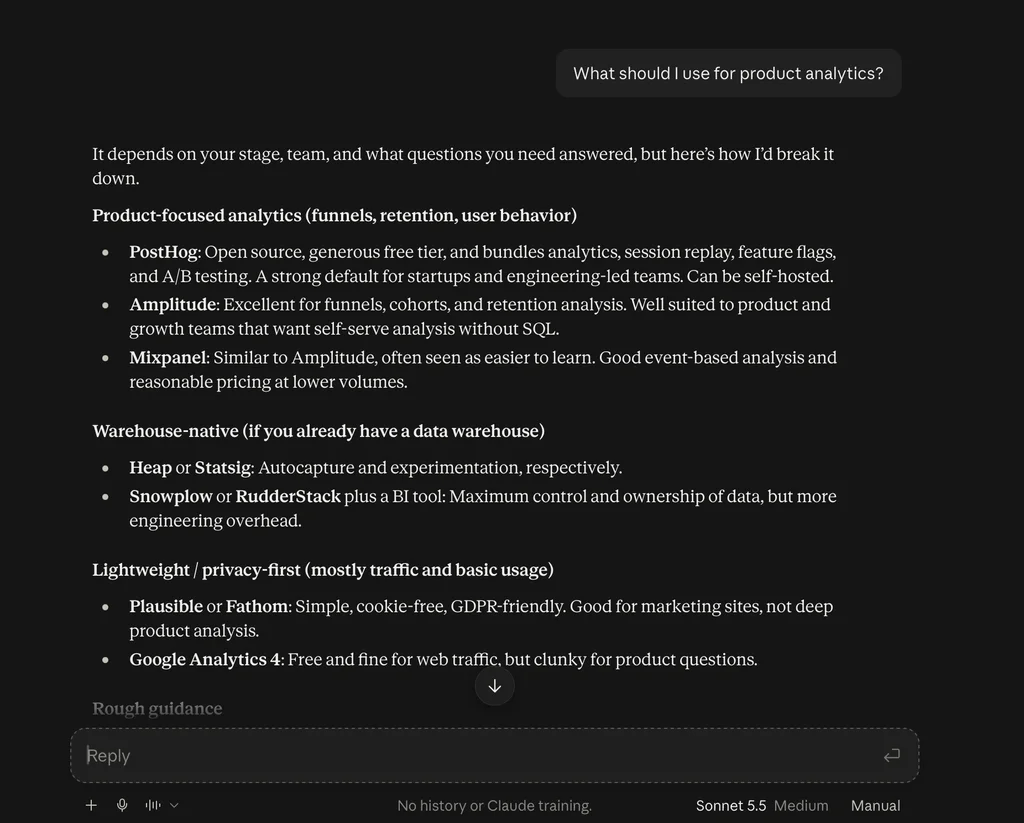
Claude puts Resend near the top for transactional email and PostHog for product analytics. We don’t know how many developers stop at the first recommendation. Still, appearing early in the answer is a position most vendors would rather have than miss.
What should I use for transactional email?
What should I use for product analytics?
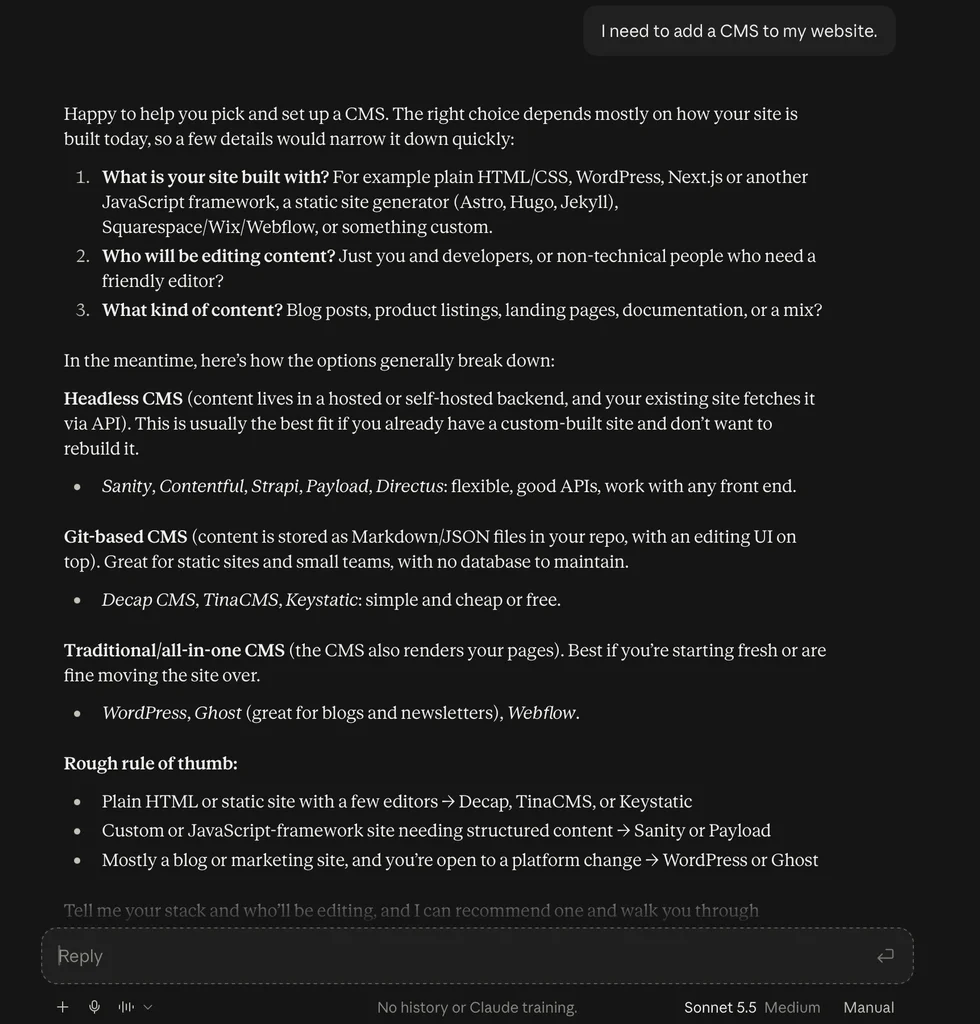
For a CMS, the prompt we expect developers to use is simpler: “I need to add a CMS to my website.” Across three runs, Claude recommended Webflow once, at the bottom of its group. In the other answers it either described Webflow as something a developer might already use or left it out. Sanity, Payload, WordPress, and Ghost appeared in all three. That’s the baseline we want to improve: what does it take for Webflow to become a default recommendation in this category?
I need to add a CMS to my website.
Tracking mentions, accuracy, and sources
We ran “Which CMS platforms support MCP integration?” 100 times between September 25 and October 19, with 25 responses from each of four engines. Webflow appeared in 49 answers. The results varied sharply: Perplexity named it 22 times, while Claude did so only four times.
“When an engine leaves us out, the developer asking never sees Webflow, and nothing in our site analytics records it because the question was answered before anyone visited a page.”
A missing mention can happen before a visitor ever reaches Webflow’s site, so ordinary site analytics won’t capture it. We also don’t have referral data linking these answers to signups or revenue. The claims we can support are narrower: whether an engine names Webflow, how it describes the product, and which sources it cites.
We track the prompt in Webflow AEO, under Insights > AEO. Its Prompts page shows each tracked question, its topic, visibility score, citation rate, and week-over-week change. Open a prompt to see response counts, citations from owned and outside domains, platform-level citation rates, cited Webflow pages, and an exportable response log.
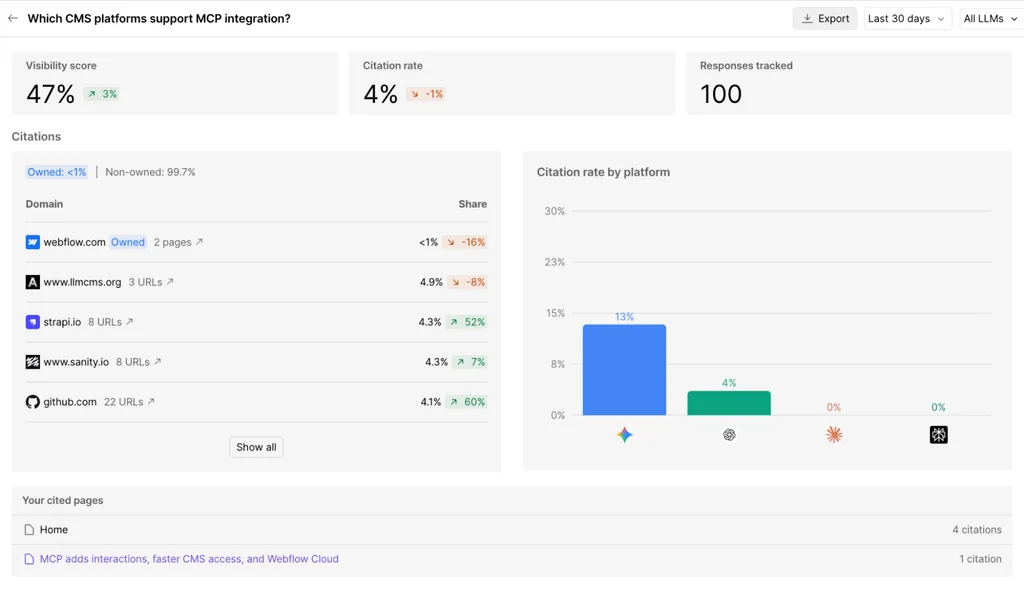
The dashboard reports 47% visibility over the last 30 days. That figure isn’t the same as our 49-of-100 mention count: visibility and a simple count of responses that named Webflow are different measures. A mention counts even if the engine gets the description wrong, so we separately review four things: whether Webflow is named, whether it’s classified as official, community-supported, or unlisted, whether the description is accurate, and what kind of source the engine used.
We’re also shifting from one exact prompt to clusters of similar phrasings. Developers express the same intent in different words, so we’ll run each phrasing across all engines multiple times and report a range for the group.
Each answer is recorded as a row. One example from the log:
JSON
{
"date": "2026-10-21",
"engine": "Claude",
"prompt": "Which CMS platforms support MCP integration?",
"mentioned": true,
"position": 6,
"listed_total": 18,
"section": "Site builders and hosted platforms",
"tier": null,
"accurate": null,
"cited_sources": [
"sanity.io",
"developersdigest.tech",
"strapi.io",
"crox.io",
"themeisle.com",
"magazine.joomla.org"
]
}
The accurate field stays blank until someone checks the answer against Webflow’s documentation. That prevents a fluent-sounding response from being treated as correct by default. The tier field is blank here because Claude didn’t say whether Webflow was official or community-supported.
Four engines, four different descriptions
The following answers were collected on the same morning. They show why a high mention count alone tells an incomplete story.
Claude placed Webflow under “Website Builders / E-commerce CMS,” describing it as having an official remote MCP server with OAuth support. It also included Webflow in a closing list of platforms “generally cited as having the most mature official implementations.” The answer was brief, and none of its sources came from Webflow. Our four manual runs suggest Claude’s wording can shift considerably between responses.
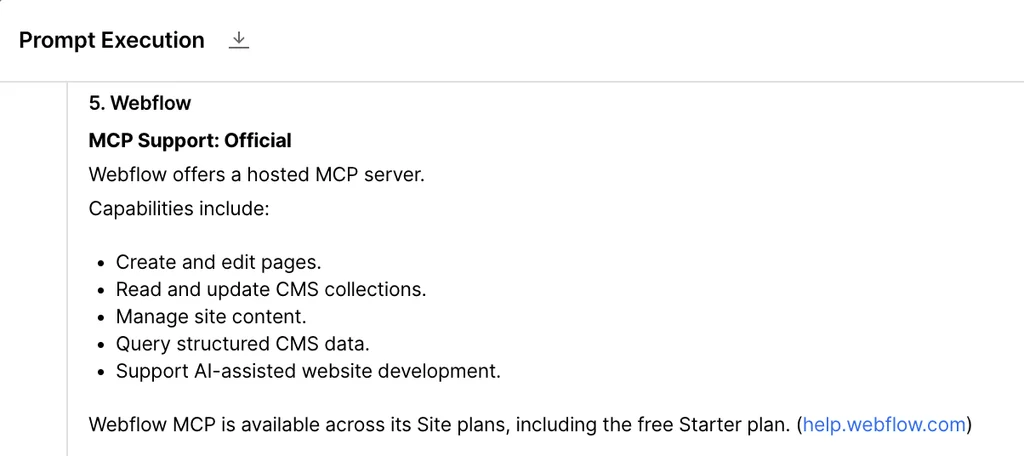
ChatGPT gave Webflow a dedicated section, labeled “MCP Support: Official.” It said Webflow offers a hosted server, outlined its capabilities, and stated that the server is available on Site plans, including the free Starter plan. It cited help.webflow.com.
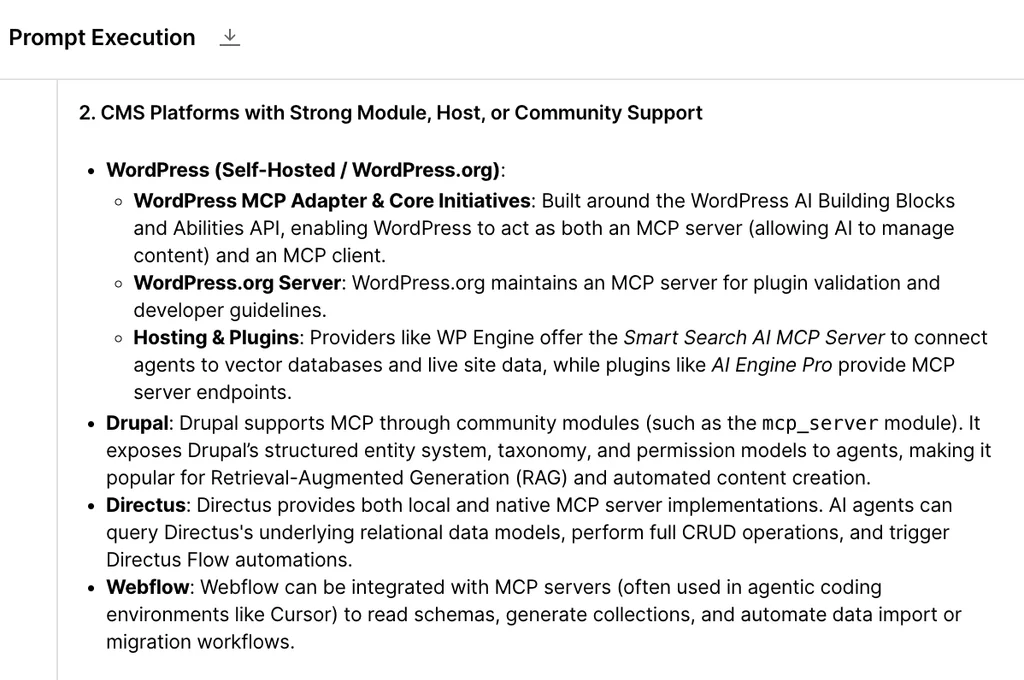
Gemini described a different setup: Webflow “can be integrated with MCP servers (often used in agentic coding environments like Cursor) to read schemas, generate collections, and automate data import or migration workflows.” That sounds like a third-party integration, not a server built by Webflow. Gemini put it in “CMS Platforms with Strong Module, Host, or Community Support,” its second tier. None of the 14 cited sources belonged to Webflow.
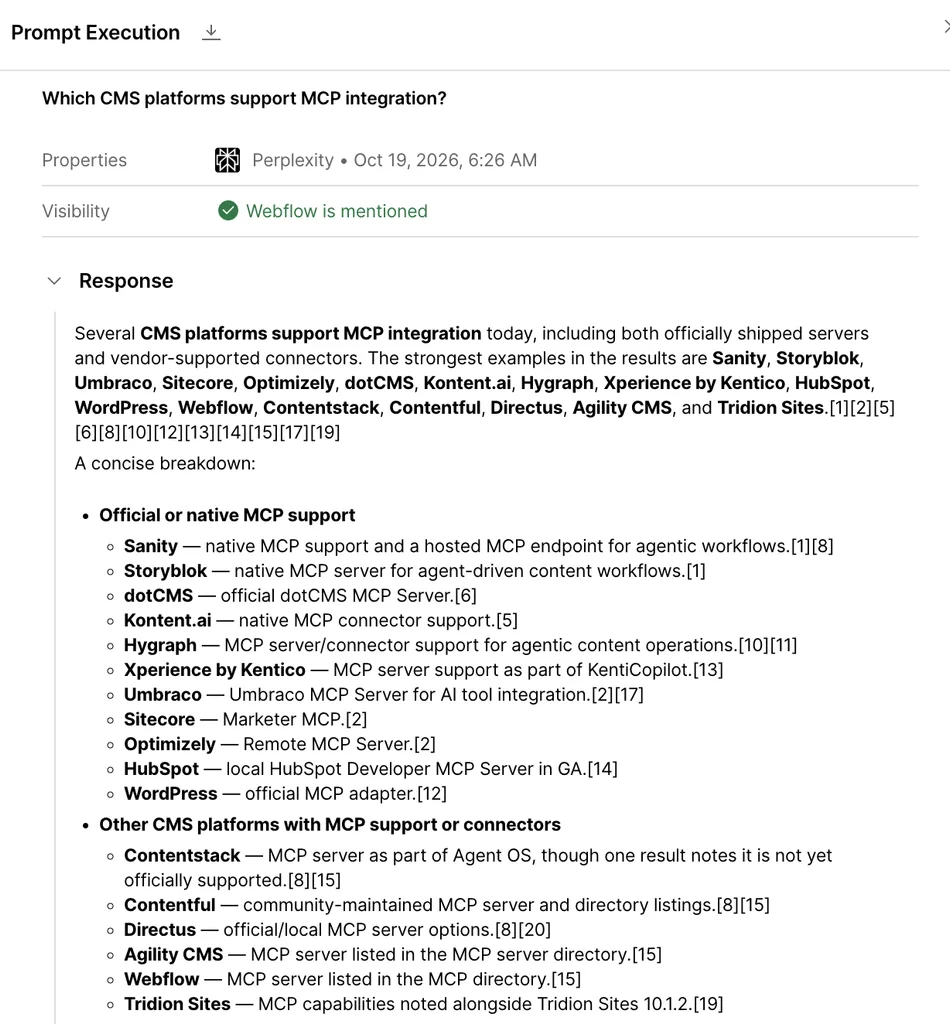
Perplexity included Webflow in its opening list, then offered a single line: “MCP server listed in the MCP directory.” It pointed to the third-party directory machalliance.org.
Webflow builds its own MCP server, which runs remotely with OAuth. On this sample, Claude and ChatGPT got that classification right; Gemini framed it as a third-party integration, and Perplexity didn’t clarify who built it.
More mentions don’t guarantee better answers
Across the 100 responses, the count by engine was Perplexity 22 of 25, ChatGPT 15, Gemini 8, and Claude 4. Perplexity led on mentions but gave the thinnest description. Claude mentioned Webflow least in the tracked sample, yet the answer we quoted was accurate. The gap between visibility and quality is the point: those metrics need separate treatment.
“Being named is the easy part for us. Being described correctly, from our own pages, is the part we can influence.”
The sources tell a related story. In the October 19 responses, ChatGPT cited vendor documentation for every platform it listed. The other engines drew on a mix of vendor blogs, third-party guides, and directories. One guide at llmcms.org appeared in 60 of the 100 responses. A Webflow domain—webflow.com, help.webflow.com, or developers.webflow.com—appeared in just six citations, all from ChatGPT or Gemini.
What the numbers can’t tell us
Answers vary with the prompt wording and from one run to another. The four Claude examples earlier were manual tests and aren’t part of the 100-response dataset. Those manual tests named Webflow more often than AEO’s tracked Claude responses did; we don’t yet know why. Mention counts also say nothing about whether an answer is accurate, which is why we score that separately.
There’s a measurement wrinkle, too: the dashboard treats webflow.com as the only owned domain. The help center and developer documentation live in separate projects, so citation share in this view covers webflow.com alone. That limitation doesn’t affect mention rate.
For now, we see this mainly as an awareness and documentation issue. We can’t claim it changes revenue without referral data connecting AI answers to business outcomes.
Actions teams can take
The steps below follow directly from what we found and can be applied to other products.
Check that crawlers can access your documentation. Send a request using a crawler’s user agent and inspect the HTTP status line:
Shell
curl -sI -A "GPTBot" https://your-docs-site.com | head -n 1
Repeat the check for each crawler. Then review robots.txt, CDN settings, and firewall rules for blocks.
Use the terms people and engines use. Webflow’s MCP documentation says the server runs remotely and uses OAuth. But the pages we reviewed don’t call it “official” or “hosted,” even though those words appeared in engine answers. Put a concise description near the top of your main documentation page: what the product is, who builds it, how it authenticates, and what it costs. For Webflow, that could read: “The Webflow MCP server is an official, hosted server built by Webflow. It uses OAuth and is available on all Site plans, including the free Starter plan.”
Close the gaps third-party guides expose. The llmcms.org guide showed up in 60 responses. Read the guides engines cite, identify what they cover that your documentation doesn’t, and make those details easy to find on your own site.
Keep listings current where engines look. Third-party guides and directories feature in these answers, including the MCP directory cited by Perplexity. Find the sources engines use in your category and check that your product is listed accurately.
Format documentation for agents. Webflow’s MCP documentation explains how to append .md or /llms.txt to a page URL. Check that these routes return readable text, that versioned URLs resolve to one canonical page, and whether pages include JSON-LD:
Shell
curl -s https://your-docs-site.com/page | grep -c 'application/ld+json'
These checks were run on Webflow’s MCP overview page:
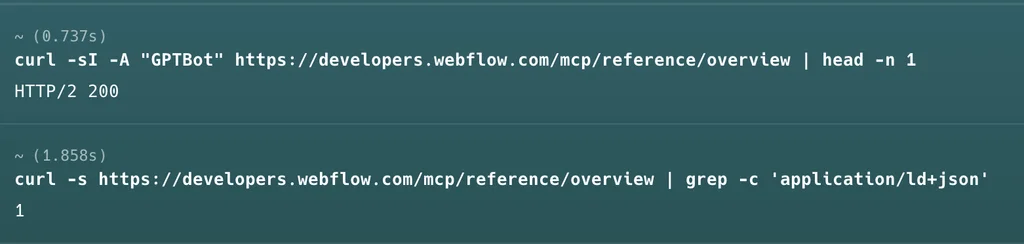
A 200 status means the page answered a GPTBot request. A count of 1 means the HTML contains at least one JSON-LD tag. A 0 means it doesn’t, unless JavaScript adds the tag after the page loads.
Include every owned domain in your measurement. If documentation sits on a subdomain, verify your tracking system treats it as yours.
Webflow’s AEO Maturity Model assesses content, technical setup, authority, and measurement for teams that want to compare their current practices.
Design documentation and tools for agents
Documentation now has two readers: the developer and the agent acting for them. That changes how products should explain themselves and expose their capabilities.
Describe tools in terms of the task they perform. An agent chooses an MCP tool using its description. “Gets a user” gives it little to work with. Spell out the task, when to use the tool, what it returns, and what happens when there’s no result. The agent sees the description, schema, and prior responses. After finding that endpoint wrappers made poor MCP tools, we rebuilt ours around intent-based tools.
“Your docs now have two readers: the developer, and the agent working for them.”
Answer specific questions directly. The most frequently cited guide in our sample lists platforms alongside the capabilities each supports. Documentation that names supported actions, scopes, and plans gives engines a clear passage to quote.
Keep the API specification in sync. A stale OpenAPI specification can mislead an agent just as outdated prose can mislead a developer. Update the specification in the same pull request as the API change.
Limit an agent’s permissions. Scoped keys and OAuth help keep an agent within the access granted by the user it represents. Webflow’s MCP server uses OAuth.
What we’ll measure next
This baseline covers mention rate, answer accuracy, and source type by engine. We plan to rerun the prompts in four to six weeks and publish ranges rather than rely on one result. Those follow-up results aren’t available yet, so there’s no evidence showing which changes will shift the numbers—or whether some will have any effect.
Try the same exercise on your product
Start with five plain-language prompts and run each through ChatGPT, Claude, Gemini, and Perplexity. These examples can be adapted to other categories:
- What should I use for transactional email?
- What should I use for product analytics?
- I need to add a CMS to my website.
- Which [category] tools support [integration you care about]?
- [Your product] vs [competitor], which should I pick?
Record every response using the fields in the sample schema, then save the baseline before changing your documentation. If an engine names your product, review its classification and description against your own docs. If it doesn’t, inspect the pages it cited. Repeat the same prompts a month later.
Teams that prefer automated tracking can use Webflow AEO, available for Enterprise. The page also offers a free assessment of a site’s AEO readiness.
First published October 28, 2026, on webflow.com.
The post Developers ask AI which tool to use. Here’s how we track the answer. appeared first on The New Stack.