Agent Standards Face a Speed Test as MCP Adoption Expands
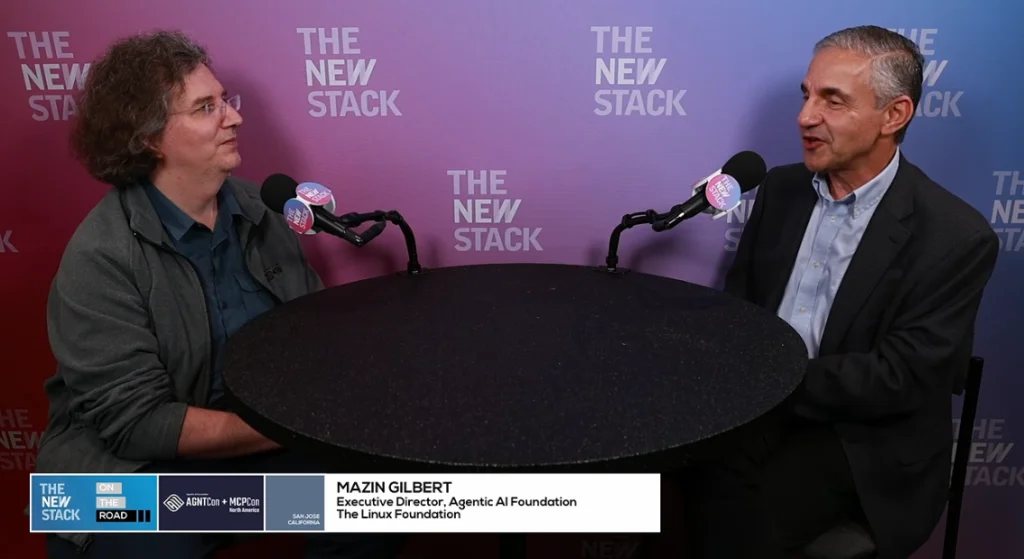
Agent standards have to keep pace with companies already shipping agent products. That’s the operating challenge facing the Linux Foundation’s Agentic AI Foundation (AAIF), according to executive director Mazin Gilbert: members will build with shared protocols when those protocols help, but they’ll also build around them when standards arrive too late.
“If this foundation does not move at the speed of light, it becomes irrelevant,” Gilbert said on The New Stack podcast, during an interview at AGNTCon + MCPCon North America in San Jose. He joined the foundation after leaving Google earlier this year. The event drew 4,300 registrants, twice the size of the foundation’s previous largest gathering in Amsterdam.
Gilbert is asking competitors including OpenAI, Anthropic and Google to align on infrastructure even as they compete in products. The practical case is straightforward: shared protocols can reduce the cost and complexity of connecting agents to business systems. But companies aren’t waiting for standards bodies to settle every detail.
Shared protocols are becoming operational infrastructure
Gilbert recently met with maintainers from companies that compete fiercely in the market but depend on common protocols. His description of their role is deliberately unglamorous: “These protocols are the air you breathe.” He also calls them plumbing. If that plumbing is poorly designed, he argues, agent deployments could become fragmented, expensive and difficult to scale.
The Model Context Protocol (MCP) offers a concrete example of standards work changing production systems. A July specification update made MCP stateless. Gilbert says participating companies contributed to the change and then updated their stacks around the new design. That kind of coordination matters because a protocol revision can affect how products manage state, connect tools and support deployments across different environments.
The adoption figures point to a community that has broadened beyond the project’s original home. MCP downloads increased tenfold during its first 10 months at the foundation, Gilbert says, after Anthropic donated the protocol last December. Anthropic now employs fewer than 15% of MCP maintainers, while more than 1,000 organizations account for 75% of pull requests, according to Gilbert. Contributors include U.S. retailers and companies elsewhere in the world.
That distribution is part of the point. A protocol can start with one company, but its long-term usefulness depends on participation across vendors and users. Gilbert describes a pattern in which large companies help establish protocols, while smaller firms extend them and turn them into enterprise products. Some startups now build on MCP and the foundation’s gateway projects to connect agents with back-end systems. A number of those businesses were pursuing different ideas six months or a year ago; others didn’t yet exist.
A fast-growing foundation still has to earn participation
AAIF has 305 members, Gilbert said in his keynote, and adds roughly one company each business day. About 40% of members are startups; nonprofits, national labs and academic institutions make up 19%. Gilbert calls it the fastest-growing foundation in Linux Foundation history, while acknowledging that neither the organization nor its members have a settled playbook for this work.
“None of us have done this before, so I just want to be very clear about that. We are learning this as we go,” he said.
Membership numbers alone don’t produce shared infrastructure. The foundation needs companies to contribute their engineers’ time, and Gilbert says that time is more valuable than membership fees. He’d like every member to participate, but says contribution levels vary. He tracks activity using his own agents, which give him a view of who is doing the work across the foundation.
For companies still working out how agents fit into their operations, joining a working group and listening can be a reasonable first step. Gilbert says participants don’t need to arrive as experts. The foundation launched its first certification in September, the Model Context Protocol Associate (MCPA), as one way to build familiarity with MCP.
The Gates Foundation, which joined in September and now has a board seat, is helping developers in parts of Africa and South Asia access training, certification and events they might otherwise be unable to afford. Gilbert says he hasn’t yet seen a divide between nonprofit and commercial members. In his view, a member’s influence rests on what it contributes, whether it’s small or large, for-profit or nonprofit.
Project selection will shape the standards agenda
AAIF has received 65 project submissions through its public intake process and has turned some down. Gilbert sees the first 10 to 20 projects as especially formative: they will help establish what kinds of work belong in the foundation and how its technical community operates.
Four projects announced in San Jose brought the foundation’s hosted portfolio to 10: Agent Skills from Anthropic, Open Responses from OpenAI, OpenEnv from Hugging Face and OpenSandbox from Alibaba. Some submissions arrive with substantial adoption already behind them, as MCP and Agent Skills did. Other areas have no settled agreement on what a standard should contain.
Gateways show how quickly that uncertainty can turn into a coordination problem. AAIF approved Solo.io’s agentgateway and Agent Router, which moved from the CNCF’s Envoy project in September. Gilbert says five or six more companies want to contribute gateway projects. That raises a question the community hasn’t answered: should the ecosystem support six or 10 gateways, or should their capabilities converge?
Neutral governance gives competitors a place to work through that question, but it doesn’t guarantee a single technical outcome. The foundation’s technical committee and governing board assess proposals, including whether AAIF is an appropriate home. Their remit spans frameworks, execution harnesses, gateways, guardrails, memory, protocols, observability and identity. Acceptance also doesn’t mean a project will become the standard.
This is a consequential distinction for platform teams. A foundation can host experimentation and establish shared practices without declaring that every project should win. The hard work is deciding where multiple implementations serve a real need and where they create integration costs that customers will have to absorb.
Agent commerce and physical systems add new protocol demands
Gilbert wants AAIF to address identity, security, trust and observability, alongside agent commerce. For an agent to complete a purchase, it may need to find a catalog, communicate with a merchant’s agent, negotiate terms, make payment, and manage returns or disputes. Each stage depends on interactions that software vendors will need to define and support.
He also sees protocol work extending beyond software systems into physical AI: agents communicating with appliances and machines rather than only with databases. Gilbert points to refrigerators and washing machines as examples, describing the prospect as science fiction that is already taking shape.
The timing of standards has a direct cost for customers. When a protocol doesn’t cover a needed interaction, companies write custom code to bridge the gap. If a standard appears only after those integrations are deployed, customers still have to maintain what they built. AAIF’s challenge is therefore measured not just by how quickly it publishes specifications, but by whether its work reaches developers before one-off connections become permanent infrastructure.
The foundation’s growth suggests broad interest in agent protocols; the next test is whether its members can turn that interest into useful, interoperable building blocks while products continue to ship.
The post Can agent standards keep up with the companies building them? appeared first on The New Stack.