Nammu21 and Google Cloud Put Syndicated Loan Workflows on a Permissioned Ledger
Syndicated loans still move through operational processes that can keep capital tied up for weeks. Nammu21’s proof of concept with Google Cloud offers a different model: translate a loan agreement into structured digital terms, then use those terms to govern approvals, transfers and payments on Google Cloud Universal Ledger (GCUL). The practical test was a $1.945 billion Term Loan B, where multiple participants shared a permissioned view of the facility.
My read is that the significant shift is in how the agreement’s rules are handled. A shared ledger can record transactions, but loan automation depends on translating bespoke legal provisions into rules participants can apply consistently. Nammu21’s Digital Credit Instrument (DCI) is designed to bridge that gap by connecting facility terms to executable contract behavior.
Turning credit agreements into executable terms
Syndicated facilities involve borrowers, agent banks and groups of lenders coordinating around customized agreements. Those documents can define tranches, covenants, eligibility requirements, consent rights and operational steps. When each organization interprets and records those terms separately, routine events can generate reconciliation work and delays.
The Loan Market Association reported that secondary market settlements for par and near-par loans averaged 42 days in the fourth quarter of 2024, with a median of 27 days. That interval reflects how much coordination sits between agreeing on a transfer and completing it. It also leaves capital and operational teams occupied while participants confirm records and approvals.
Nammu21’s platform processes a credit agreement into a DCI, mapping each relevant term back to the provision that established it. The instrument describes what a facility permits, requires or blocks, and connects those conditions to the loan’s live state. That creates a structured representation of the agreement that can inform the contract managing activity on the ledger.
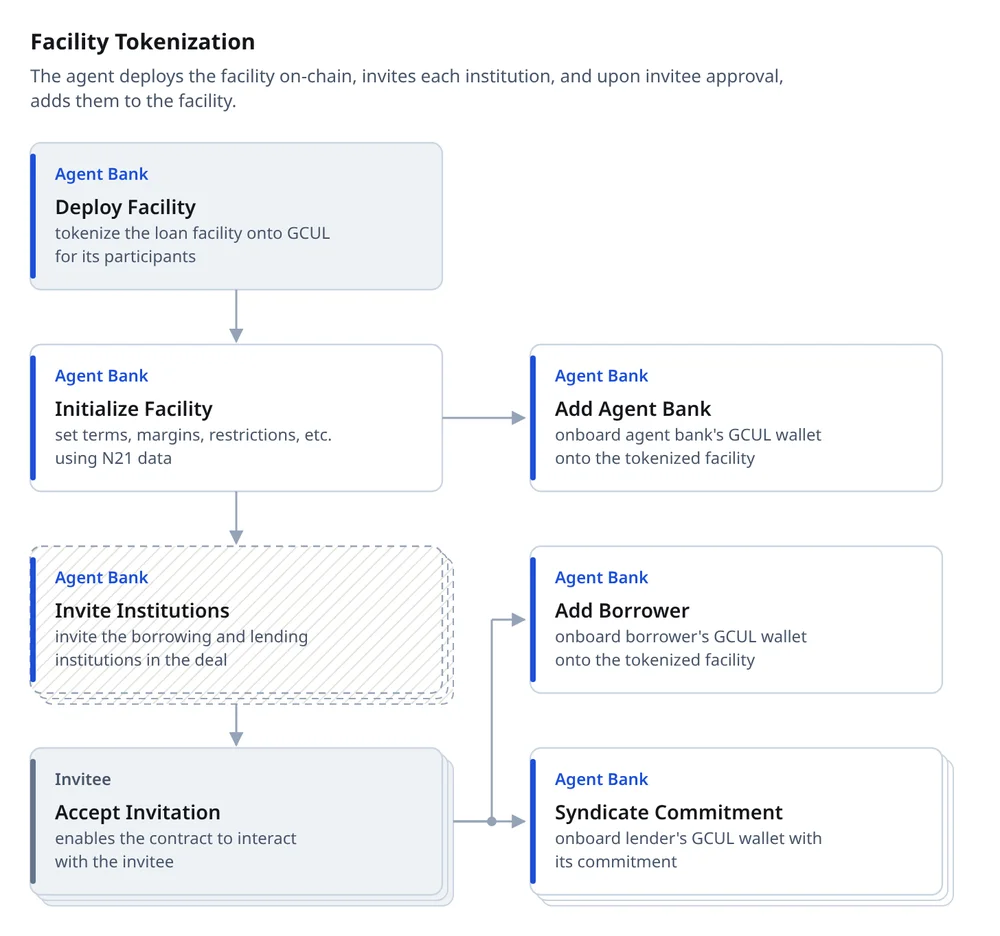
In the pilot, an agent bank selected a credit agreement that Nammu21 had processed. The platform supplied its structured terms, which were used to create a facility-specific contract on GCUL. The result was a digital representation of that loan, with its operating logic tied to the source agreement.
Consent and permissions shape the workflow
GCUL is a permissioned distributed ledger intended for institutional financial workflows. In this implementation, the agent bank begins onboarding the borrower and lenders, but each participant must review and approve the invitation through its own interface. Once onboarding is complete, the agent records an immutable hash of the loan’s key terms on the ledger, providing an attestation that the on-ledger representation matches the canonical off-ledger records.
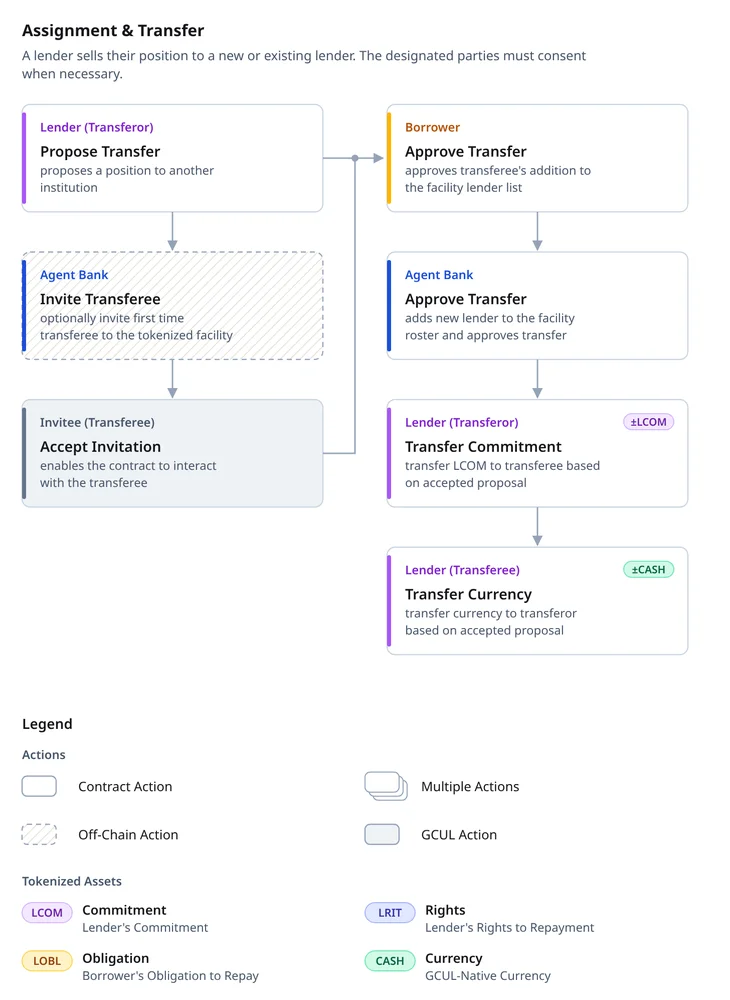
That consent model also applies when a loan position changes hands. A secondary market transfer requires approval from the incoming lender, borrower and agent bank before the ledger executes the transaction atomically. Payments, including interest and loan close-outs, are designed to settle on GCUL using tokenized commercial bank money, keeping the payment step within the same workflow.
Here’s the thing: automation only helps if it respects the roles and conditions in the credit agreement. Nammu21’s contracts use the DCI terms to check proposed actions before they execute. That can prevent an invalid transfer or a covenant breach from proceeding unnoticed, while making the reason for a blocked action traceable to the governing terms.
GCUL’s access controls are intended to limit visibility according to participant roles, so sensitive positions and transaction information can remain available only to the parties that need them. Its permissioning also requires explicit authorization before a contract stores data on a user’s behalf. This addresses a familiar issue on open networks, where an organization can receive assets it never chose to interact with.
A contract language built for financial logic
The contracts in the proof of concept are written in gculpy, a statically typed subset of Python designed for GCUL. Its stated design goals include readability, safety and auditability for financial rules. The language also avoids some low-level development demands found in other ledger environments, letting engineers focus on the transaction logic without managing memory or working around restrictive call stack limits.
Nammu21 supplies two connected parts of the system. It first derives the DCI from the legal agreement, then uses the structured terms to generate gculpy contracts that define the obligation and govern its activity on GCUL. This link between document provisions and executable behavior is central to the design: participants can work from shared terms, while the contract checks whether a requested action fits those terms.
The ledger’s other stated properties are deterministic execution, near-instant transaction finality and predictable costs. Together with role-based access and participant approval, these capabilities are intended to support high-value workflows that require privacy and coordination across institutions.
What the pilot demonstrates
The $1.945 billion Term Loan B modeled one segment of a larger, multi-facility transaction. The agent bank, borrower, transferor and transferee operated from a permissioned view of the same on-ledger loan representation. That setup shows how a facility’s legal and operational state could be shared among the parties involved in a transaction, while access remains controlled.
The potential operational benefit comes from applying the same governing logic at each stage of the loan lifecycle. Participants would have a common reference for approvals and transaction conditions, and the ledger could complete an authorized transfer or payment without a separate round of manual reconciliation. If that approach works at scale, it could reduce delays and back-office effort while lowering the risk that parties act on conflicting interpretations.
That said, the source describes a proof of concept, not market-wide deployment or measured settlement results. The 42-day average and 27-day median provide context for the delays the system aims to address; they do not establish how much this implementation would reduce them. The pilot’s more concrete contribution is its demonstration of a workflow connecting agreement terms, participant consent, contract checks and payment settlement.
The same pattern could apply to other forms of credit where terms are bespoke and handled through manual interpretation. The next meaningful measure will be whether institutions can use this model across real facilities and counterparties while preserving the agreement’s detail. If they can, programmable loan terms may help secondary markets move from repeated document checks toward transactions governed by shared, verifiable rules.


