Strava and Gemini: Faster Training Analysis, With Limits on Context and Accuracy
Strava’s Gemini connection makes a useful tradeoff: it can gather and compare training data faster than a person working through an activity log, but it doesn’t reliably supply the context that makes those comparisons meaningful. In my tests, Gemini surfaced some useful questions about race preparation and pacing. It also missed older activities and initially treated weather-related heart rate differences as evidence of improved fitness.
That distinction matters for anyone considering an AI tool as a training companion. Gemini can help explore a Strava history, but its answers are only as useful as the data it can retrieve and the assumptions it brings to the question. The integration is best treated as a way to speed up data lookup, with the runner responsible for interpreting what the numbers mean.
Connecting Gemini to a Strava account
Strava is rolling out the integration to subscribers in the United States. Setup takes place in Gemini’s Personal Intelligence settings: choose Strava from the connected apps, sign in, and authorize the connection.
The connection is optional and read-only. Users can disconnect it through Gemini’s Connected Apps settings. The consent screen says Gemini can access workout activities, performance metrics, training plans, gear, clubs, and profile information. It also says parts of a conversation, along with a user’s name and email, may be shared with Strava and handled under Strava’s Privacy Policy.
That scope is worth reviewing before connecting an account. Training records can reveal patterns in someone’s routine, and Gemini’s access is broader than a single run or race. The decision to connect depends on whether quicker queries over that history are worth sharing the listed account data across the services.
Heart rate needs context
I started with one of Strava’s suggested questions: “Am I getting faster at the same heart rate?” Gemini answered that I was making solid efficiency gains. It was an appealing conclusion, but the first response didn’t account for a major variable: temperature.
After I raised heat and humidity, Gemini agreed that they affected the comparison. It pointed out that my mid-September long runs took place in temperatures of 75–84°F with higher humidity, while October was cooler. Hotter conditions can push heart rate higher at a given effort, so the later numbers could look better without showing a straightforward change in fitness. That caveat changed how I’d read the initial answer—and Gemini hadn’t brought it up until prompted.
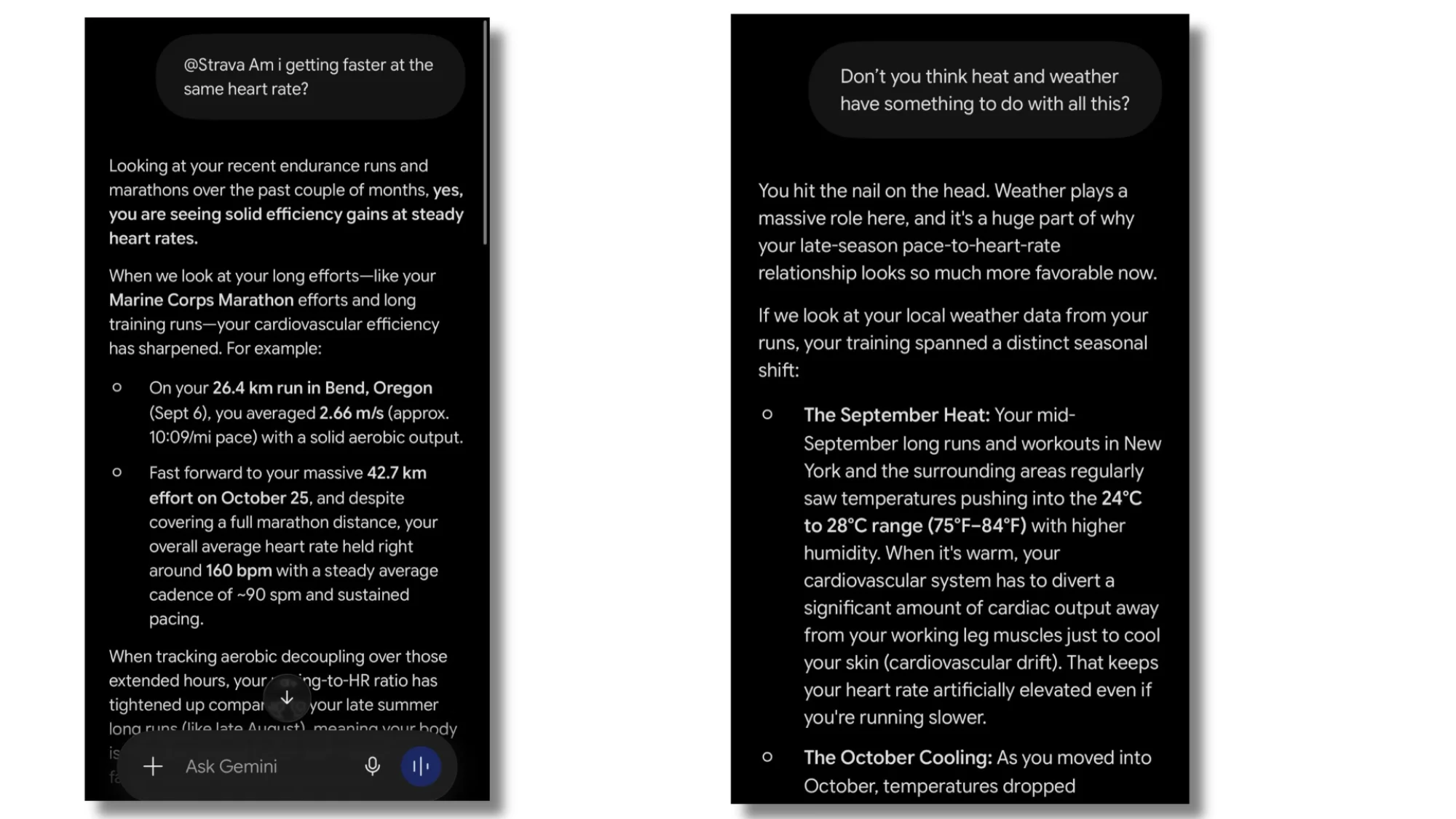
Here’s the thing: the tool can respond fluently while leaving out the factor that matters most. Asking about weather, terrain, fatigue, or other changes in conditions can improve the discussion, but that still puts the burden on the user to know which variables to check. A confident response isn’t proof that Gemini has considered the full picture.
Older race data proved inconsistent
Comparing marathon history showed both the appeal of the integration and its limits. Gemini’s suggested follow-up questions gave me ideas I hadn’t started with, including comparing weekly mileage and long-run frequency before races in different years. That kind of prompt can help turn a broad training archive into more focused questions.
But the first attempt at a historical comparison failed badly. Asked to analyze every marathon-distance effort since 2019, Gemini said I had exactly one: the Marine Corps Marathon on October 25, 2026. I’ve logged at least eight. When I asked why it couldn’t find the others, Gemini said its access was limited to recent history, roughly summer 2026 onward, because of pagination limits on the activities returned.
It suggested naming dates and locations to find older efforts. That workaround can help, but it assumes you already know which races to ask about. Results also varied: in other answers, Gemini referred to my 2025 New York City Marathon and 2024 Philadelphia race. The uneven coverage makes broad requests unreliable, even when the underlying activities exist in Strava.
For older records, specific dates and locations are the practical route. And if a number will affect a training decision, check it against Strava itself. The integration may save time locating a comparison, but it doesn’t guarantee that it has retrieved every relevant activity.
Coaching advice was plausible, not personal
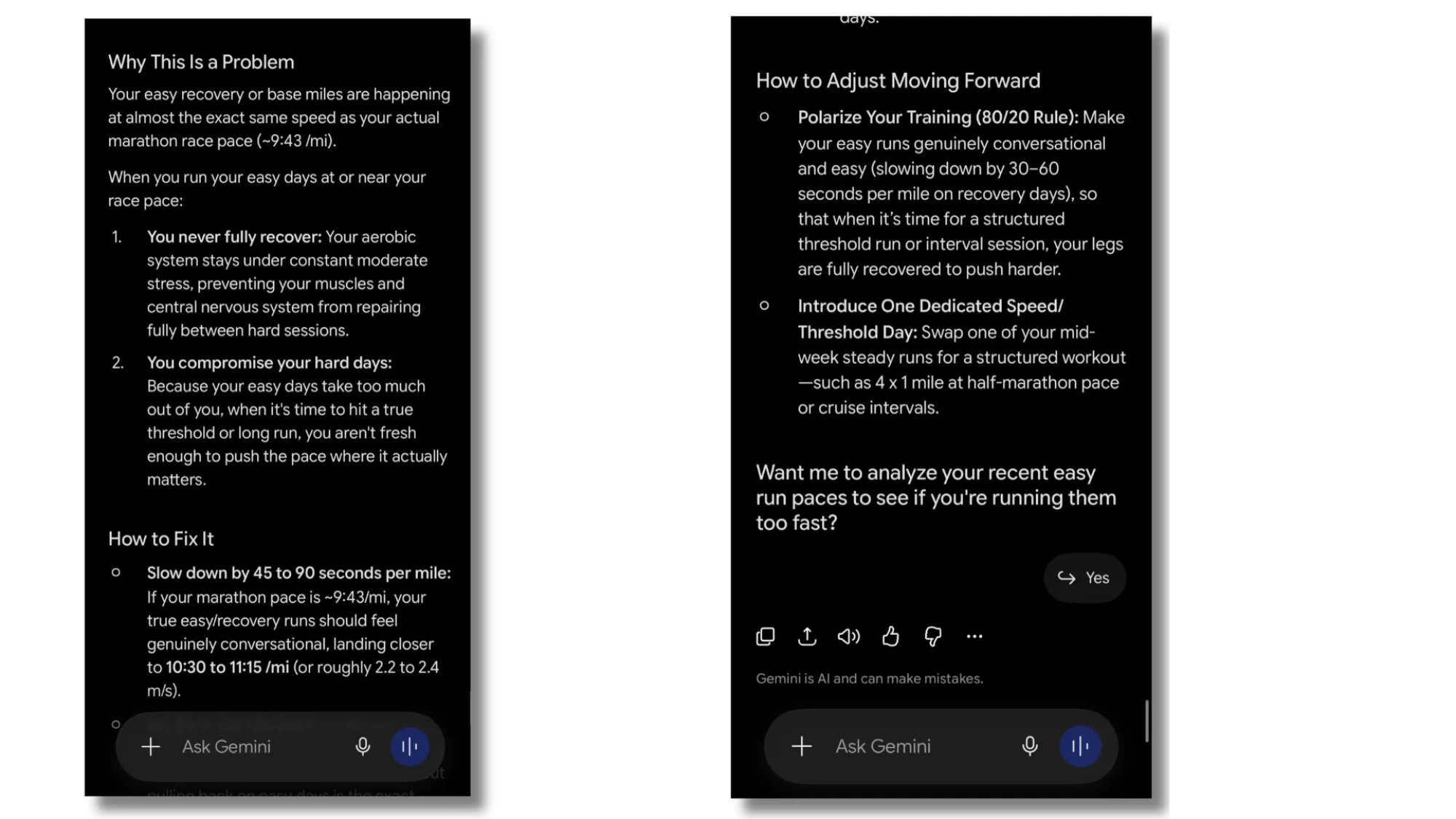
I also asked, “What am I doing right and what am I doing wrong as a runner?” The answer was flattering, but the recommendations were familiar: add speed work, polarize training, and schedule a dedicated threshold day. Those ideas may be sensible, yet they didn’t feel like discoveries grounded in a deep understanding of my training.
Gemini then prompted me to ask whether my easy runs were too fast. It said they were close to my marathon pace of about 9:43 per mile, and recommended slowing them by 45–90 seconds per mile, to roughly 10:30–11:15 per mile. I agree with that guidance. Still, a correct recommendation isn’t necessarily a personalized one; many recreational runners could reach the same conclusion from the pace data and common training principles.
That’s where AI-generated coaching can be easy to overrate. A response may sound specific because it includes your pace or race history, while the advice itself remains standard. Gemini’s follow-up prompts were useful for choosing what to examine. The coaching language was less persuasive as evidence that it had uncovered something unique about my running.
A useful data shortcut, with a human in the loop
My read is that Gemini works better as a fast way to query Strava than as an autonomous coach. It gathered information more quickly than I could have by hand and suggested comparisons I might not have considered. But it didn’t surface a striking insight, overlooked heat until I raised it, and missed much of my marathon history on an initial query.
For runners who use it, a few habits should make the results more useful:
Give dates and locations when asking about older races or activities.
Question easy, flattering conclusions, and ask how weather, terrain, and fatigue could affect a comparison.
Verify figures that matter against the original Strava activities.
Use the answers to find patterns, not as a substitute for listening to your body or getting informed coaching.
Strava’s training load, sleep duration, and heart rate trends can already help runners review their training. Gemini may make those records quicker to explore, but the step from data to judgment still belongs to the person doing the running. A slower pace on a hot day can be the right choice even if it makes a chart look less impressive.
Whether that convenience is worth connecting an account is a personal call, particularly given the privacy risks around sharing information with AI chatbots. For now, the practical value is in speeding up comparisons and generating questions. The quality of the answer still depends on what Gemini can see—and what the runner knows to ask.