Google Cloud’s Self-Managed VMware Service Adds VCF 9.x on Z3 Bare Metal
Google Cloud is handing VMware customers the controls—and the maintenance burden
The significant part of Google Cloud’s new VMware offering is the shift in who runs the stack. Customers can bring VMware Cloud Foundation (VCF) subscriptions to dedicated Google Cloud bare metal and retain full administrative control, including the ability to manage updates and integrations themselves. For teams trying to leave a data center without rewriting established operating procedures, that choice may matter more than the cloud location.
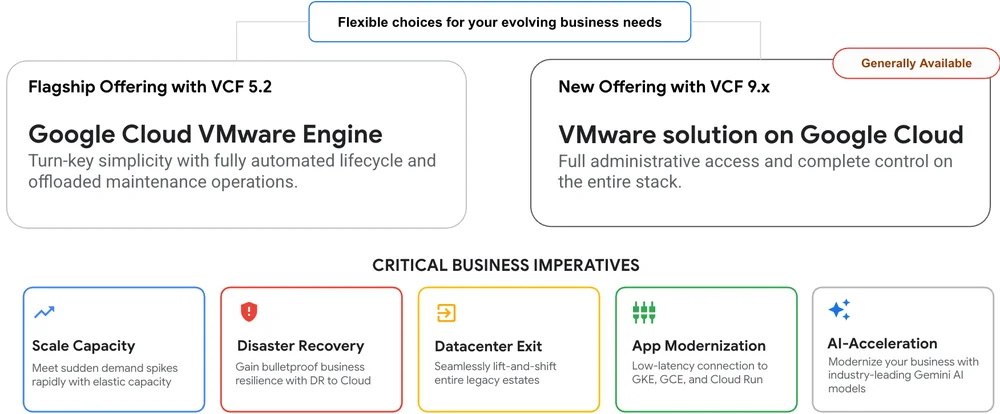
Now generally available, the VMware solution on Google Cloud sits within the Google Cloud Modernize portfolio. It complements Google Cloud VMware Engine, Google’s managed service. The new model is aimed at organizations that need control over their virtualization stack, maintenance windows, and third-party monitoring and management tools. That flexibility comes with responsibility: lifecycle work can be customer- or partner-driven rather than handled by Google.
Broadcom’s VMware Cloud Foundation 9.x is a key reason for the launch. Its unified VCF control plane supports deployment and lifecycle management across the stack, and Google says customers can use it to access Broadcom’s latest features while making use of their VCF licenses.
“Customers want the agility of Google Cloud without rearchitecting their VMware environments or abandoning the operational practices they have invested in. With the new VMware solution on Google Cloud, VCF license portability allows customers to bring their existing subscriptions and run their VMware workloads unchanged, with complete administrative control on dedicated Z3 bare metal and the ability to apply Google Cloud commitments and discounts to optimize their costs.”
— Abhay Kumar, Global Head of Hyperscalers, VMware Cloud Foundation Division, Broadcom
Two operating models, different trade-offs
Google Cloud now offers two paths for VMware workloads. VMware Engine favors turnkey operations: Google handles patching, updates, and monitoring, with customers receiving role-based vCenter privileges. The new VMware solution gives customers full root access across ESXi, vCenter, NSX Manager, and the rest of the VCF components, along with direct control over lifecycle management.
The underlying software and hardware differ, too. VMware Engine runs VCF 5.2 on ve1 and ve2 node families; the new option runs VCF 9.x on dedicated Compute Engine bare metal, such as Z3 instances. Both support portable bring-your-own VCF subscriptions. The practical choice is whether your team values Google-managed operations or needs to own and customize more of the stack.
Z3 brings high capacity—and a broader cloud connection
The self-managed service runs on dedicated GCE Z3 bare metal instances, including the z3-highmem-192-highlssd-metal shape. Each node uses 2.2 GHz fourth-generation Intel Xeon processors (Sapphire Rapids) and provides 96 physical cores, or 192 hyper-threads, 1.5 TB of RAM, 72 TB of all-flash NVMe storage, and 200 Gbps networking.
Because the infrastructure runs natively alongside Compute Engine and Google Kubernetes Engine (GKE), workloads can connect to Google Cloud services such as BigQuery, the Gemini platform, and Cloud Run. Google also cites high bandwidth and low latency as benefits for transactional databases. The deployment uses VMware vSAN hyperconverged infrastructure with local NVMe drives; those drives can also serve as a memory tier. NetApp volumes are supported as external storage.
“VMware solution on Google Cloud gives enterprises greater control, choice, and architectural freedom as they move to the cloud. We are excited to expand our partnership with Google Cloud by offering NetApp Volumes as an external datastore. Together, we’re helping customers confidently migrate their VMware workloads and data to Google Cloud while retaining the flexibility, performance and data management capabilities they rely on.”
— Pravjit Tiwana, SVP/GM, Cloud Storage, NetApp
The savings claims depend on how the system is configured
Google presents several ways VCF 9.1 and Z3 may reduce costs. Customers can bring portable Broadcom VCF subscriptions and apply Google Cloud commitments and Flexible Committed Use Discounts (Flex CUDs) to Z3 bare metal. Google says NVMe memory tiering between DDR memory (Tier 0) and local NVMe (Tier 1) can cut server total cost of ownership (TCO) by up to 40%. Its estimate for vSAN Express Storage Architecture (ESA) is up to 39% lower storage TCO compared with traditional external arrays. Active live patching can cover up to 80% of critical security updates, reducing planned maintenance downtime.
Those are upper-bound figures, and the announcement doesn’t explain the workloads or configurations behind them. Treat them as potential outcomes to validate against your own environment, not guaranteed savings.
Google also points to three operating frameworks—Google-, customer-, or partner-managed—alongside bare metal sizing across Compute Engine hardware families. For networking, it cites Andromeda and Network Connectivity Center (NCC) support for connecting multi-edge and multi-VPC topologies. Direct links from systems of record to BigQuery and Gemini are positioned as a route to AI capabilities.
“Our early assessment shows significant potential. Separating the hardware lifecycle from the virtualization layer gives us the ability to scale bare-metal capacity in minutes, while still retaining full administrative control. This provides the flexibility of the cloud with the level of control we require from our infrastructure platforms.”
— Scott Ronan, Senior Director of Platforms, Databases & Cloud, GXO Logistics
Partners can take on implementation and ongoing operations
Organizations that want the self-managed deployment but lack the capacity to run every phase themselves can work with Google Cloud partners experienced in both Google Cloud and VCF. The partner role can span architecture and design before deployment (“Day 0”), deployment and migration (“Day 1”), and lifecycle management and operations afterward (“Day 2 and beyond”).
Partners and availability
Google’s self-managed VMware offering leaves room for customers to work with their existing service providers or choose from a featured partner network. That flexibility matters: migration and operations still depend heavily on the support model a company already trusts. Featured providers include Accenture, Advanced Business Computing, Cognizant, Devoteam, HCL, IBM, Infosys, Insight, LiverX, ModernZ, Pellera, Quantiphi, Tata Consultancy Services, Wipro, and Xtravirt. They can deliver the service through professional or managed services contracts.
How to evaluate it
The service is generally available in 22 Google Cloud regions, and Google plans to add more in coming quarters. That gives customers a concrete starting point, though regional coverage may still shape where deployments make sense.
If you’re assessing the offering, start with the VMware solution on Google Cloud webpage, then review the solution overview and core concepts. From there, talk with your Google Cloud account team or an authorized partner about whether the model fits your environment.