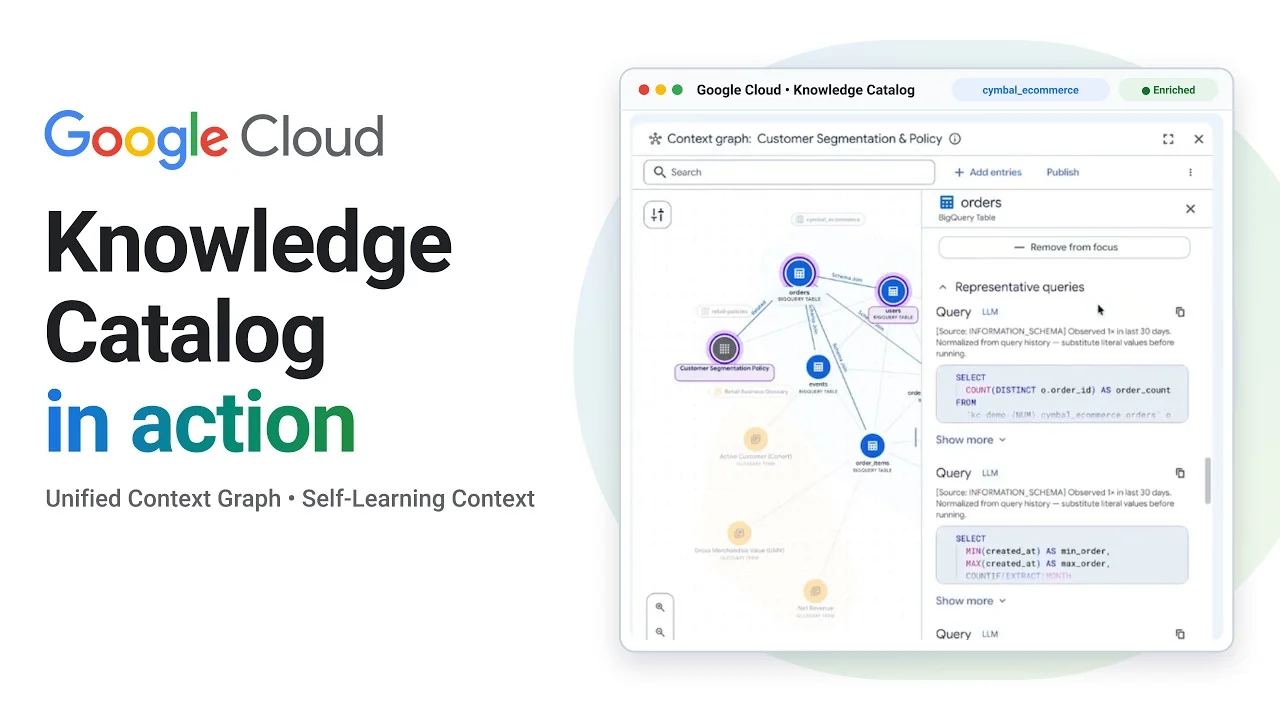
Google Cloud Adds Self-Learning Context Enrichment to Knowledge Catalog
Enterprise agents can return confident answers built on stale definitions or incomplete data relationships. Google Cloud’s new self-learning context enrichment for Knowledge Catalog is designed to catch those gaps by learning from agent and user interactions, then proposing updates for people to review. Paired with a redesigned Knowledge Studio, the preview features aim to make business context easier to maintain as organizations scale their use of agents.
The practical shift is from documenting context once to maintaining it as a feedback loop. Knowledge Catalog already uses Gemini to enrich business context; the new capability analyzes interaction traces to identify where agents struggle, finds relevant definitions in company sources, and stages proposed changes. Data stewards can review those changes before they reach the context used by agents.
From interaction traces to proposed context updates
Consider an agent asked for net revenue in EMEA last quarter. A reliable answer depends on the organization’s definition of net revenue, the tables that hold bookings, and how those tables connect. Those details may be spread across a finance playbook, a data model in GitHub, and a Confluence page. If partner credits are treated differently in a later quarter, a static definition or hardcoded formula can quickly become wrong.
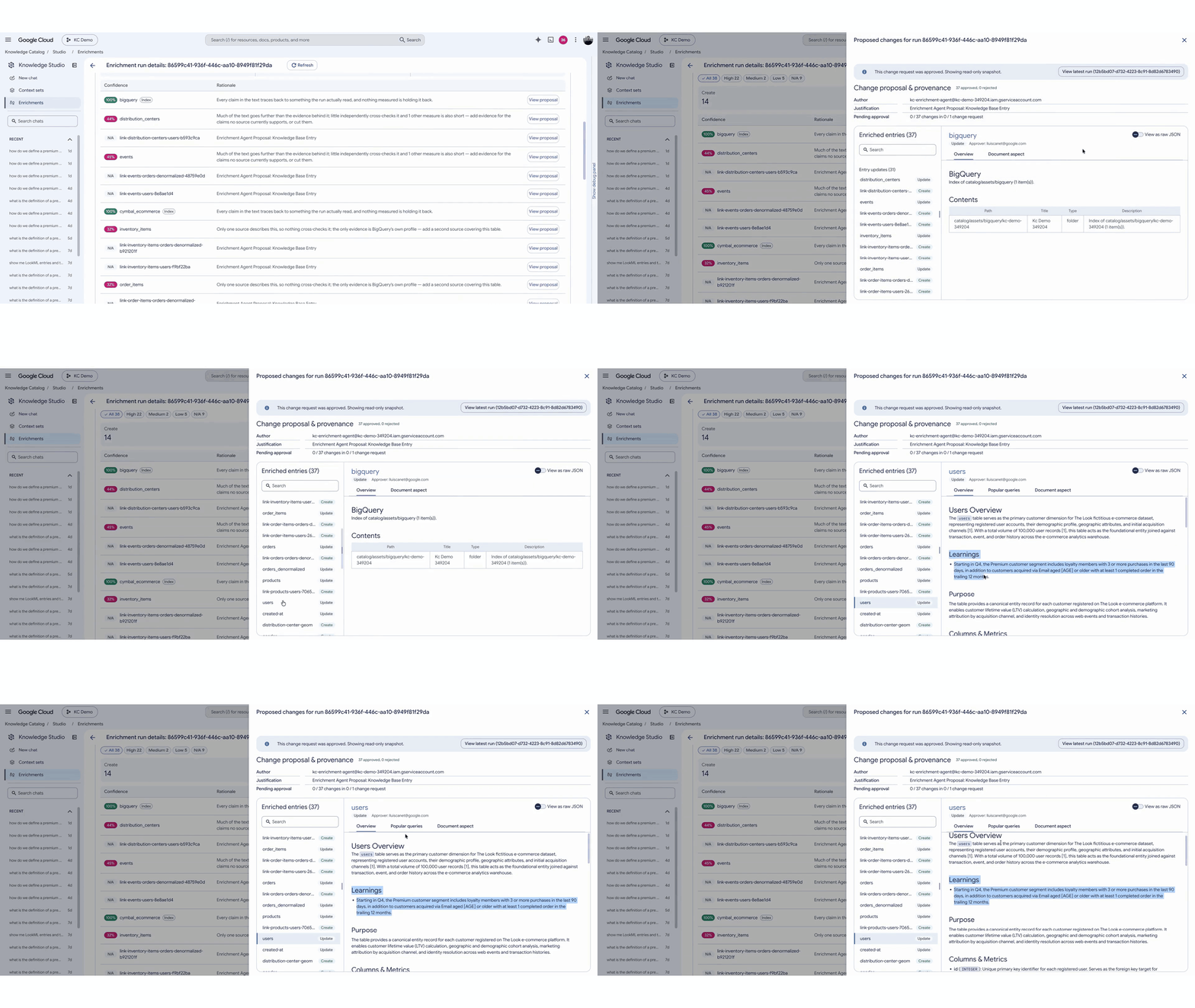
Knowledge Catalog connects structured data from first-party and third-party sources with unstructured material stored in Cloud Storage, Google Workspace, GitHub, Confluence, and SharePoint. It links documents such as playbooks and wikis to metadata such as tables and schemas. On demand or on a schedule, enrichment can propose business definitions, table and column descriptions, join relationships, golden queries, and task-specific agent instructions. Each proposal includes source citations and a confidence score.
Each run checks source material for changes, retires definitions that are no longer current, and flags conflicts for review. The system can also analyze interaction traces from Gemini agents, Conversational Analytics in BigQuery, and custom agents. Google says users can configure this analysis to redact personally identifiable information. The system looks for patterns such as ambiguous column lookups, unsupported metrics, missing definitions, or users repeatedly rephrasing a question. It then searches for an authoritative answer and stages a context change intended to prevent the same problem from recurring.
This puts expert effort into reviewing proposed fixes rather than writing every definition and mapping from scratch. The model matters as organizations move beyond a small number of agents: maintaining context manually becomes harder as more teams and agents depend on shared business knowledge.
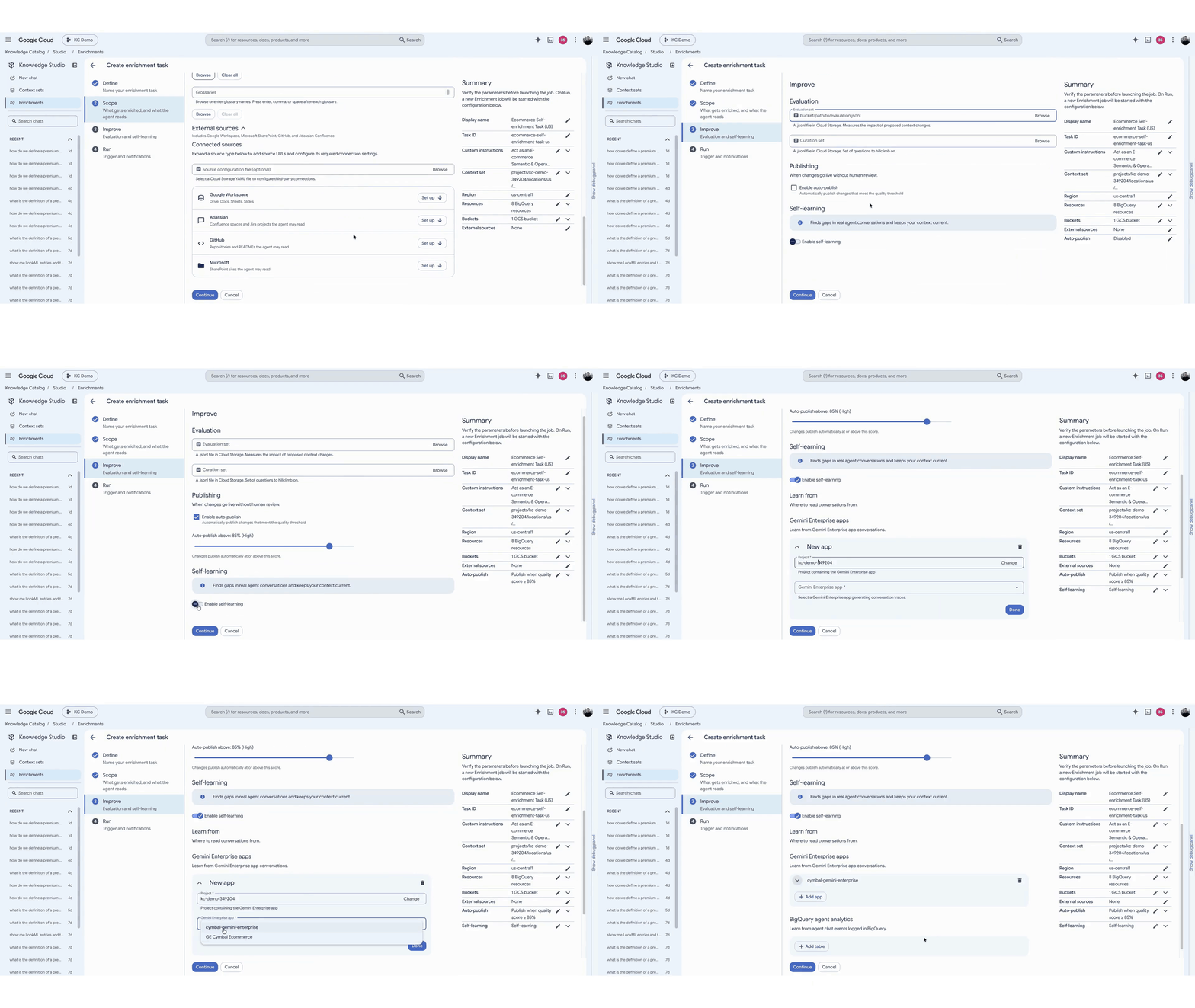
Configuring an enrichment task with connected sources, evaluation, and self-learning
Review controls and governed context sets
Automation still leaves publication decisions with the organization. Teams can switch auto-publishing on or off and set a confidence threshold—for example, 85%—for changes that may be approved automatically. Lower-confidence proposals and sensitive changes such as deletions become Change Requests for a steward to approve, edit, or reject. Teams can also supply evaluation sets to test proposed updates end to end.
Knowledge Catalog logs changes with provenance and supports reverting them. Google says customer data is never used to train its models. These controls are central to the workflow: a generated definition can affect how multiple agents interpret company metrics, so reviewers need to see its sources and confidence before it becomes shared context.
Reviewing enrichment proposals, confidence scores, and change diffs before publishing
Knowledge Catalog organizes reusable context into context sets: governed subsets of the broader context graph containing definitions, metrics, join logic, and golden queries for a domain, team, agent, or user group. A sales agent might use a Sales context set, while a finance assistant uses Finance. That arrangement allows each domain to define a term such as “net revenue” for its own needs within the same catalog.
An agent can be assigned a context set or search the catalog dynamically for context relevant to a task. Access is managed through IAM, allowing stewards to decide which agents and users can read, use, or edit each set. Agents retrieve only context they’re authorized to access, while permissions on the underlying data continue to apply.
Updates remain traceable and reversible. Context sets also use the Open Knowledge Format (OKF), so teams can import an OKF bundle as a context set and export context back into that format. That portability gives organizations a way to move context without locking its structure inside a single catalog workflow.
Approved enrichments published to a governed context set
Knowledge Studio brings exploration and review together
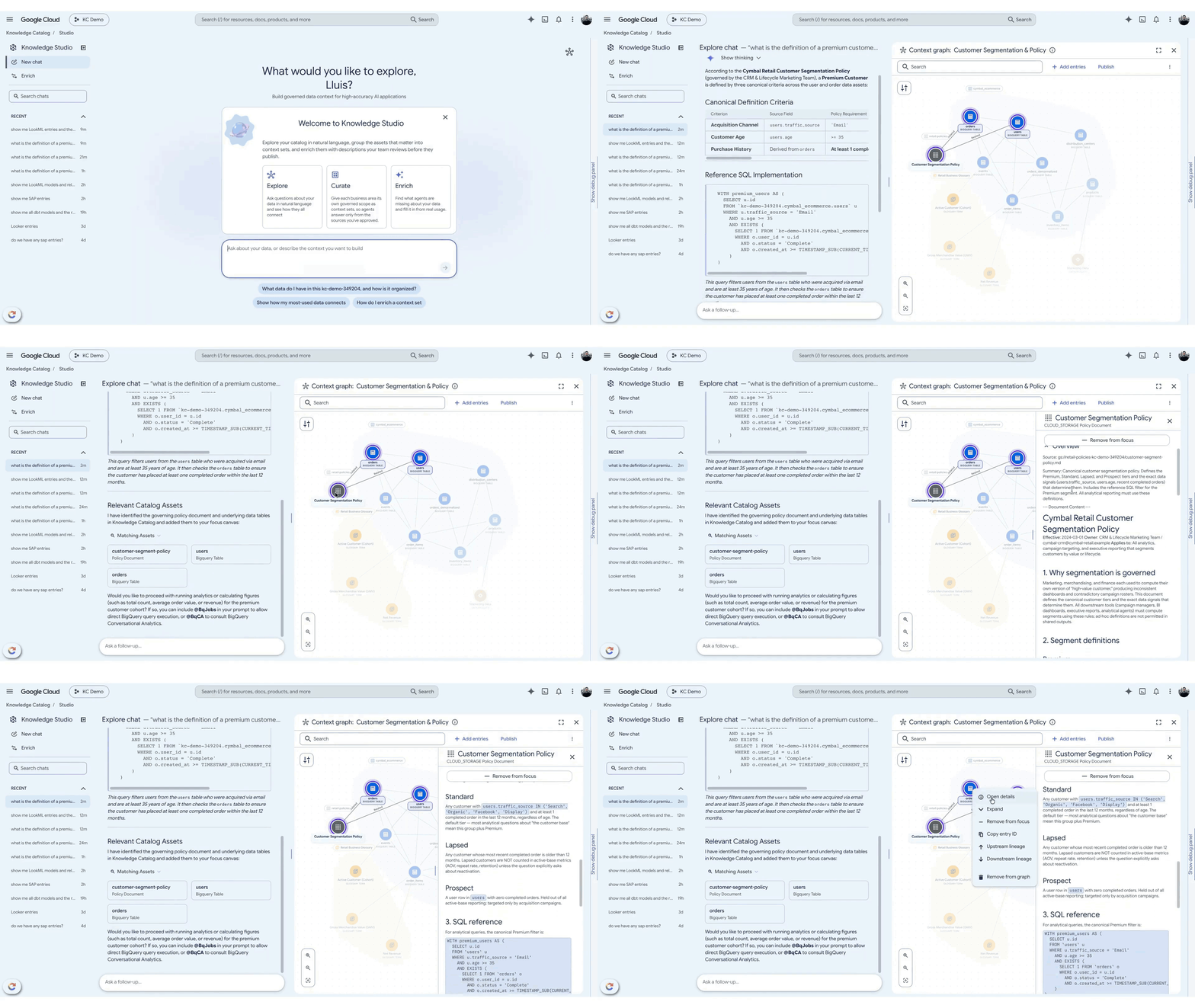
The redesigned Knowledge Studio is the new workspace for context engineers and data stewards. It gives them a visual view of the context graph and a conversational way to explore the data estate, while bringing enrichment review and monitoring into the same experience.
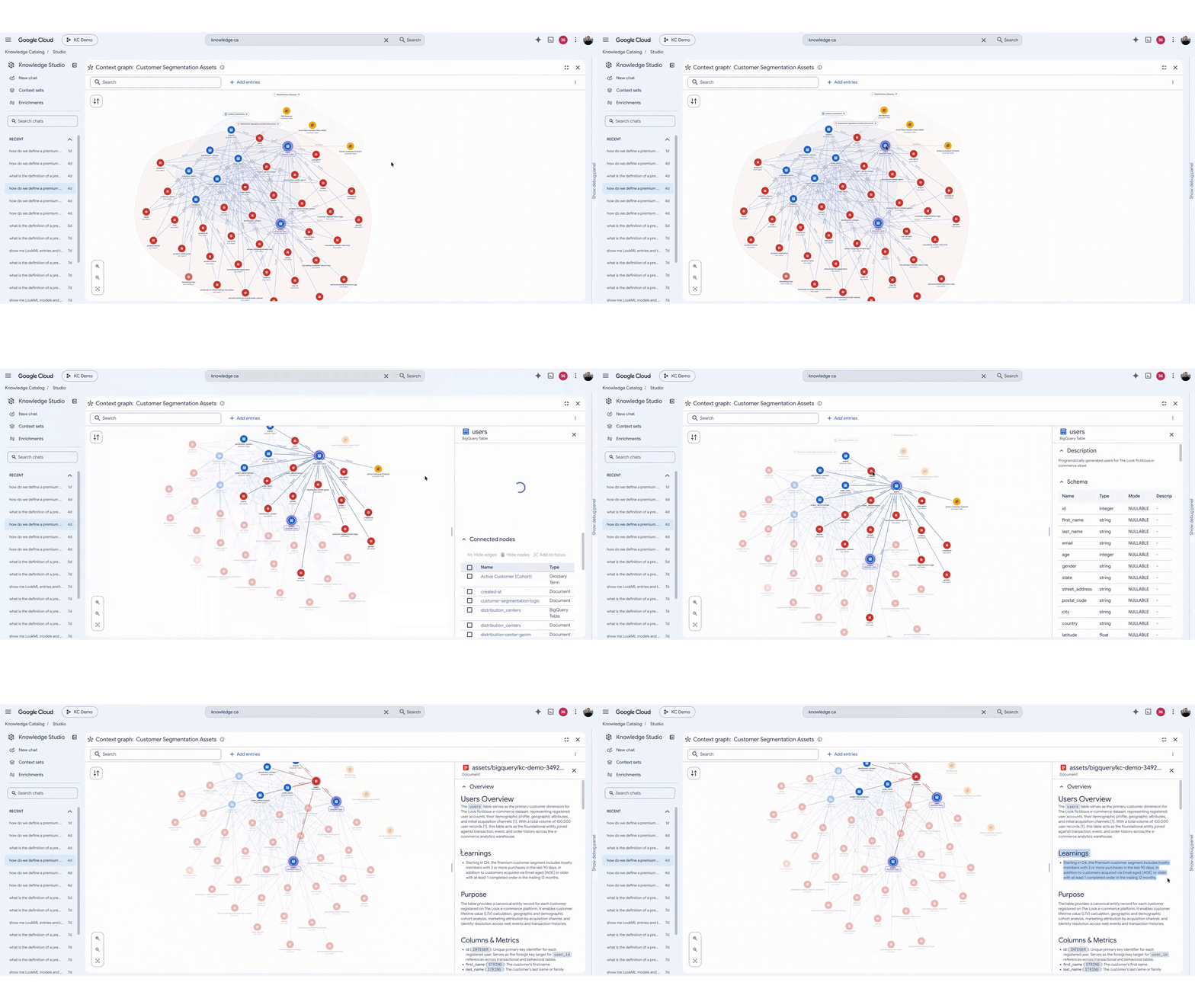
Navigating the context graph visually in Knowledge Studio
Stewards can inspect coverage across a cross-cloud data estate, including operational databases, warehouses, semantic models, context sets, and documentation. They can ask business questions in natural language, follow relationships through the context graph, and see how agents reason over metadata. For proposed enrichments, the workspace shows the change, its source citations, and its confidence score. Teams can test context sets against real questions and approve, edit, or roll back requests using software-style version control.
Knowledge Studio also tracks enrichment schedules, results, token use, and run duration, with email notifications when a run finishes. That operational view helps teams see what enrichment is doing over time, alongside the content changes it proposes.
Google says the preview features will roll out to customers over the next few weeks. Organizations can sign up to request immediate access and consult the documentation for setup guidance. Google’s internal benchmarks report nearly four times greater agent accuracy, up to 33% lower latency, and up to 75% fewer tokens with Knowledge Catalog; those figures are based on internal testing. The more durable test will be whether the feedback loop keeps shared definitions aligned with how teams actually work as agent use expands.