Edge detection serves as a fundamental technique in computer vision, allowing systems to identify discontinuities in images that suggest boundaries. It's a topic that's gained increased traction in recent years, especially with advancements in artificial intelligence and machine learning that have revolutionized how we approach visual data. The relevance of edge detection isn't just limited to algorithms but extends to a deeper understanding of biological visual systems, a connection that David Marr deftly explored in his seminal work, Vision.
Marr proposed a three-tiered framework for understanding any information-processing system, emphasizing that a comprehensive analysis requires perspectives from:
The computational level: What are we solving and why? In this case, edge detection is about determining where significant changes occur in an image.
The algorithmic level: How is this problem approached? For edge detection, this means exploring various algorithms like the Canny detector and the Laplacian of Gaussian.
The implementation level: Where do these methods apply in practice, whether in biological systems like the human retina or through digital processing techniques?
What is striking here is how Marr's insights remain relevant, bridging the gap between computational theory and the biological understanding of vision. His arguments suggest that to grasp the complexities of visual processing, we must consider all three levels concurrently. The concepts he introduced have not only influenced computer science but have also resonated within neuroscience, leading to compelling discussions around the biological parallels of computational procedures.
In focusing on edge detection, we initiate a discussion that taps into both Marr’s theoretical underpinnings and the practical algorithms developed since then. As we proceed, we will define key edge detection algorithms and evaluate their effectiveness, drawing parallels to how biological systems process visual information. This connection is not merely academic; it profoundly impacts how we could enhance machine vision systems today.
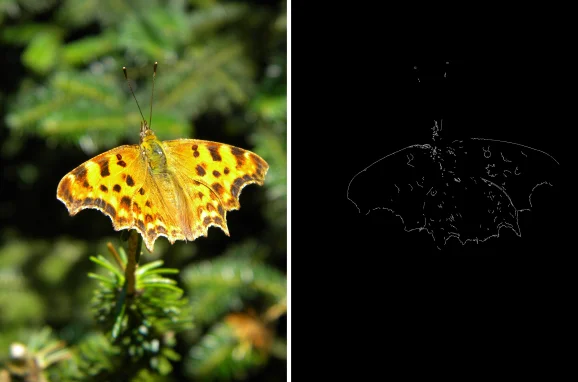
A demonstration of Canny edge detection applied to a butterfly image. This process illustrates the practical application of edge detection algorithms in visual recognition tasks.
Understanding Gradient Operators
When it comes to edge detection, Prewitt operators stand out for their simplicity. They assign equal weights to all neighboring pixels, allowing the detection of gradients in the image. The formulas for the Prewitt gradient in the x-direction (\(G_x\)) and the y-direction (\(G_y\)) can be represented in matrix form. Each operator is intended to highlight the changes in intensity along the respective axes, which is crucial for identifying edges in images.
However, despite their straightforward approach, Prewitt operators do come with a downside: noise sensitivity. This means that even minor variations can create false positives and lead to thick, indistinct edges. As a result, every pixel with a significant gradient value can be flagged as an edge, irrespective of whether it genuinely represents a boundary. This shortcoming is precisely what John Canny aimed to address through his more sophisticated edge detection algorithm.
Canny Edge Detection: A Paradigm Shift
Canny's seminal 1986 paper, *A Computational Approach to Edge Detection*, is not just an academic milestone; it’s the foundation of modern edge detection techniques. In it, Canny redefined edge detection as an optimization problem that aims to meet three essential criteria: accurate edge detection, precise localization of edges, and a single response per edge. This multifaceted strategy significantly minimizes the shortcomings of earlier methods, including the thick and noisy edges produced by operators like Prewitt.
Canny’s algorithm unfolds in four distinct phases:
Phase 1: Noise Reduction with Gaussian Smoothing
The initial phase involves applying a Gaussian filter to minimize noise interference in the image. The choice of the filter's width, represented by the parameter \(\sigma\), is a pivotal aspect of this step. If \(\sigma\) is too large, it blurs the genuine edges of the image, whereas a \(\sigma\) that is too small might leave too much noise. This balance is critical for capturing essential details without compromising edge clarity.
Phase 2: Gradient Computation
Next, the smoothed image is subjected to gradient computation typically via Sobel filters. This operation yields the magnitude of the gradient, which indicates the strength of the edges, and the direction, which pinpoints where these changes occur. The expressions for the gradient magnitude \(\|\nabla f\|\) and angle \(\theta\) enable algorithms to discern strong contrasts in pixel intensity.
Phase 3: Non-Maximum Suppression (NMS)
Following gradient calculation, Canny introduces Non-Maximum Suppression to thin out the edges. The algorithm evaluates each pixel to determine if it represents a local maximum along the gradient direction. If a pixel is not the highest within this context, it is set to zero, producing a preliminary edge map that is one pixel wide.
Phase 4: Hysteresis Thresholding
The final phase employs hysteresis thresholding with two distinct thresholds: high and low. Pixels above the high threshold are marked as edges, while those below the low threshold are discarded. Importantly, pixels falling between the two are only accepted as edges if they are connected to strong edges, ensuring continuity even in the presence of noise. This connectivity analysis effectively addresses the weaknesses seen in earlier methods and is what sets Canny's approach apart.
To understand this process visually, tools like the OpenCV documentation on Canny edge detection can be invaluable resources for a deeper dive into the mechanics and applications of these techniques.
Final Thoughts on Edge Detection
As we wrap up, it’s clear that the journey through edge detection techniques reveals much more than just lines on an image. We’ve explored how foundational concepts from biology, particularly the workings of retinal ganglion cells, have influenced computational methods. Notably, the connection from Marr’s theories to practical algorithms like the Canny edge detector emphasizes a blend of theory and application that continues to shape the field.
Key Insights
Let’s crystallize what we've learned:
1. **Zero-Crossings**: The idea that edges correspond to zero-crossings of the second derivative of image intensity has robust grounding in both theory and empirical validation. It’s more than just a mathematical abstraction; it aligns closely with how our visual system processes information.
2. **The LoG Operator**: As a bridge between smoothing and edge detection, the Laplacian of Gaussian operator plays a pivotal role in emphasizing significant edges while mitigating noise. This balance is critical in ensuring the reliability of subsequent image analyses.
3. **Canny Edge Detection**: With enhancements like Non-Maximum Suppression (NMS) and hysteresis, the Canny algorithm sustains a reputation for delivering thin, well-defined contours. What stands out is not just the effectiveness but also the elegance of adaptively retaining edge continuity while minimizing fragmentation.
Looking Ahead
In an era where deep learning promises to redefine image processing, edge detection maintains its relevance. It acts as a cornerstone for various advanced applications that warrant exploration:
- **Hough Transform**: This remains a powerful method for detecting geometric shapes directly from edge maps, demonstrating that classical techniques can still hold their ground against neural network approaches.
- **Contour Analysis**: Relevant in object detection, contour-based methods are often overlooked but can outperform in specialized tasks, especially where data is limited.
- **Medical Imaging**: Here, edge detection isn’t just a relic of the past; it actively complements sophisticated AI models for critical applications, such as spotting anomalies in thin structures.
Edge detection may seem simplistic against the backdrop of deep learning's capabilities, yet it grounds us in a deeper understanding of visual data manipulation. That said, as algorithms become increasingly complex, the straightforward elegance of edge detection serves as a reminder that foundational principles deserve recognition and continued exploration.
Thanks for diving into this topic with me. Keep questioning and exploring!