Understanding the Limitations of Agent Harnesses in Cloud-Native Environments
The advent of cloud-native architectures has ushered in substantive shifts in how software is developed and deployed. However, as developers embrace the increased flexibility offered by microservices, they are finding that traditional feedback mechanisms can fall short in these complex environments. The disconnect between an agent's operations and the feedback required to validate those operations in a distributed system is becoming more pronounced, calling into question how we think about agent efficiency in coding tasks.
The building blocks of an effective coding agent—prompt engineering, tools, context policies, and feedback loops—interact to govern an agent’s behavior. Addy Osmani highlights a striking case: a coding agent performed significantly better when simply switched to a different harness, climbing the rankings from 30 to 5 on Terminal Bench 2.0. These findings suggest that enhancing the scaffolding around a model could yield more transformative results than merely upgrading the underlying model itself. What’s clear is that the structure in which these agents operate impacts their effectiveness far more than previously understood.
The Crucial Role of Feedback
In any successful coding environment, feedback loops serve as a linchpin for improvement. Traditionally, success signals can be silent—when a type check passes, the agent simply resumes operations, while a failure spurs immediate corrective action. Yet in the context of cloud-native applications, this signal is not just important; it is essential. The challenge lies in how to deliver this feedback at runtime when actions may span multiple microservices, databases, and stateful contexts.
Unlike localized applications where feedback can be obtained quickly and easily through environment spins, cloud-native systems complicate this process. Indeed, while individual components might pass their tests in isolation, the real test of a coding agent in a distributed system hinges on its ability to validate real-time behavior among interdependent services. Mocks or stubs, often used in unit testing, fall short as they cannot replicate the nuanced interactions that lead to bugs surfacing in production environments. This mismatch underscores a major blind spot in coding agent effectiveness: inadequate feedback can lead to reinvestment of human resources, as agents lack the data needed for self-correction.
What Cloud-Native Architecture Breaks
Even with continuous integration (CI) setups following a pull request, the feedback loop gets disrupted. Once an agent makes its changes, it faces delays waiting for human review within an actual environment. This hinders the agent's ability to operate autonomously, elongating feedback loops into hours rather than minutes. As a result, the critical insights that agents require to forge ahead in code changes are often relegated to afterthoughts, delivered too late to be actionable.
The scale at which distributed systems operate further complicates feedback mechanisms. Full preview environments, while beneficial, strain budgets and resources. Expecting agents to run their separate instances consistently invites additional overhead, hampering productive engagement with the codebase. The clear takeaway? The existing harness model gets agents to a point of tentative success but effectively halts there, leaving gaps that require manual intervention.
Rethinking the Feedback Loop
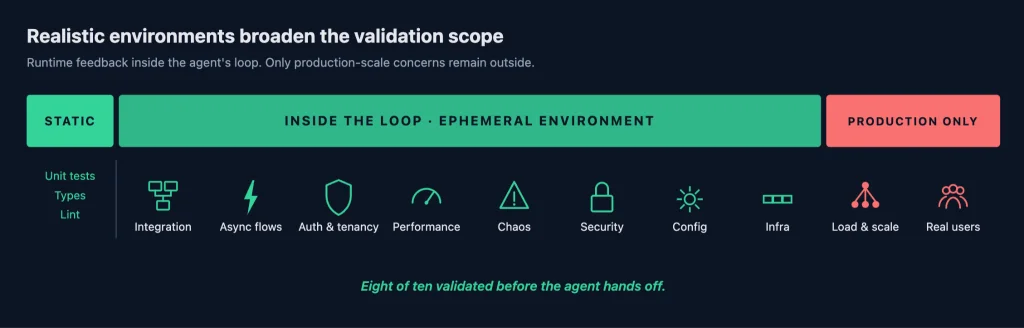
For agents to drive genuine progress in cloud-native applications, they need to work within a meticulously structured environment. Instead of a confined sandbox, developers should explore frameworks that allow agents access to real service interactions. This means not just validating individual changes, but ensuring feedback reflects true runtime conditions as they unfold. This leads us to the essential requirements for such an environment: it must be inexpensive, quick to deploy, realistic, programmable, and isolated enough to prevent cross-contamination of actions from multiple agents.
Environments that can meet such demands represent a significant leap forward. They would permit agents to interrogate their changes against real user traffic and respond to stateful dependencies effectively. Consequently, when these agents assert that a code change is successful, they can back it up with valid evidence—traces of executed code, integration validations, and observability metrics—all assessed on environments mirroring production quality.
Implications for Development Cycles
The possibilities become transformative once agents can validate their actions against a responsive runtime environment. They can execute comprehensive end-to-end tests that not only cover code changes but also affirm contract behaviors among services, thus reducing reliance on human reviewers. This shift elevates PR discussions from the labored query of “Does this work?” to a more strategic “Should we ship this?” As a result, developers can arrive at a more nuanced understanding of the system as a whole rather than being mired in trivial error-checking.
Future Directions for Harness Engineering
The insight gained from reengineering agent feedback mechanisms could redefine the future of software development. Harness engineering, as it is, has proven successful in creating coding agents that can autonomously adapt and iterate, but its efficacy in distributed systems is fundamental to the next evolution of coding practice. Without addressing the infrastructural limitations that affect feedback loops, the potential gains in productivity and quality will remain unrealized.
The onus is now on technology teams to develop lightweight environments that enable agents to execute validated changes at unparalleled speeds and scales. Creating runtime feedback loops that provide realistic insights into operational contexts within distributed systems will be essential to turning the tide in cloud-native software development. The roadmap is clear: prioritize environments over mere sandboxing to truly empower coding agents. Establishing these connections could catalyze a new wave of productive, efficient coding practices that redefine how teams build and maintain cloud-native applications.