Understanding Agentic RAG: A Multi-Level Breakdown
Unlocking the Potential of Agentic RAG
Understanding agentic Retrieval-Augmented Generation (RAG) is essential for anyone looking to enhance their approach to AI-driven information retrieval. Traditional RAG systems are efficient for straightforward queries but struggle with complexity. They retrieve content based on a one-time process, which can lead to incomplete or irrelevant answers—especially when addressing multi-faceted inquiries. This article explores agentic RAG, an evolution that incorporates autonomy into AI systems beyond the limitations of its predecessor.
With traditional RAG, you get a single pass at retrieving information; if the results miss the mark, you’re left with the same unrefined pieces of data, incapable of adapting to the nuances of more complicated questions. For instance, a query like “Contrast Q3 2025 sales figures with those for Q1 2026 and identify key risk factors in our most recent SEC filing” could yield irrelevant or incoherent chunks of data. This lack of dynamism illustrates how traditional models can falter when faced with complex tasks.
On the contrary, agentic RAG transforms this process by introducing AI agents that autonomously interact with diverse data sources. These agents break down the original query into manageable subtasks, intelligently routing each component to the most relevant resource. They not only gather data but also evaluate and refine their findings through an iterative process, ultimately generating much more reliable outcomes.
This article will walk you through three distinct levels of understanding agentic RAG. First, we’ll outline how it improves upon traditional methods. Next, we’ll break down the mechanics behind the agentic retrieval loop, focusing on techniques like query decomposition and multi-hop reasoning. Finally, we’ll examine advanced architectures such as Graph RAG and discuss the trade-offs involved in real-world production scenarios.
Why Traditional RAG Isn't Enough
Traditional RAG operates in a linear fashion—retrieve, then generate. This fixed approach lacks iterative capabilities. When receiving a complex inquiry, the system merely pulls the most relevant documents in one shot, making it ill-equipped for multifaceted tasks that require more nuanced handling. As a result, it can yield a mishmash of disparate pieces that fail to adequately answer any single aspect of the query.
Consider a request that necessitates a deeper analysis of sales performance and risk factors. The static, one-and-done nature of basic RAG means the system can only output a collection of chunks that may not effectively connect all the dots. Without the ability to break the query down or synthesize information accurately, users often receive unsatisfactory answers. This underlines a crucial limitation: static RAG is not designed for understanding the complexities inherent in multi-part inquiries.
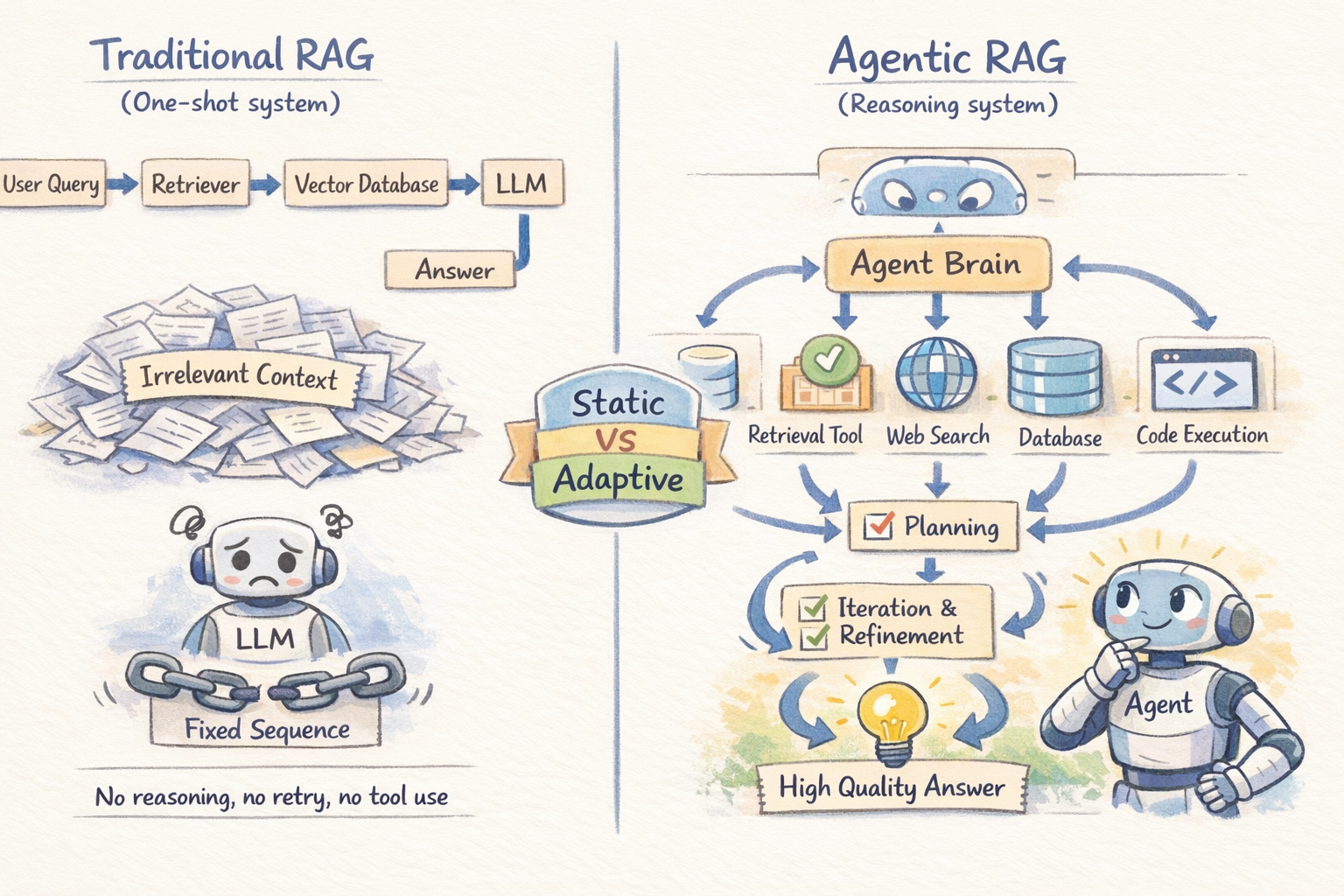
Basic RAG vs. Agentic RAG
Empowering RAG with Autonomy
What sets agentic RAG apart is its incorporation of AI agents—systems powered by LLMs that can independently think, plan, and act based on their findings. These agents not only execute tasks but also engage in decision-making processes, enhancing the RAG framework in three key ways:
- Planning: Agents decompose complex inquiries into subtasks, creating a strategic pathway for information retrieval.
- Tool use: They leverage multiple data sources, from databases to web searches, ensuring they access the most relevant information for each specific query.
- Iterative refinement: These systems reassess their findings, improving their results through successive retrievals until they arrive at a coherent, accurate answer.
By incorporating these intelligent mechanisms, agentic RAG systems dramatically improve the quality and reliability of responses, particularly in complex scenarios that require nuanced understanding and detailed synthesis of information. As you continue exploring agentic RAG, consider how these advancements can be applied in your work for a more efficient and effective retrieval process.